500 AI Stress Relief Prompt Guide
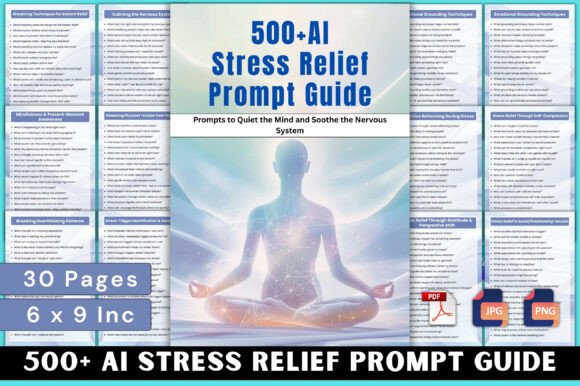
If your mind feels like a browser with 47 tabs open—most of them playing audio—you’re not alone. Stress today isn’t just “busy.” It’s layered: cognitive overload from back-to-back Zoom calls, physical tension from hunching over laptops, emotional fatigue from navigating uncertainty, and sensory drain from constant notifications. That’s why the 500 AI Stress Relief Prompt Guide stands out—not as another self-help checklist, but as a precision tool for nervous system recalibration.
This isn’t a passive workbook. It’s a responsive, journal-style collection of over 500 thoughtfully sequenced prompts designed to meet stress where it lives: in the body, the breath, the thought loop, the boundary breach, or the unmet need. Each prompt is grounded in evidence-informed practices—polyvagal theory, ACT, somatic awareness, trauma-informed care, and mindfulness-based stress reduction—but stripped of jargon and delivered with quiet clarity. You won’t find vague affirmations or prescriptive advice. Instead, you’ll encounter questions like *“Where in your body does ‘I can’t catch up’ settle—and what does that sensation ask for, not fix?”* or *“What’s one boundary you’ve softened this week to avoid conflict—and what small reassertion would feel both kind and firm?”*
Why Structure Matters More Than Volume
The number “500” isn’t about quantity—it’s about coverage. Most stress journals offer 30–50 prompts scattered across vague themes. The 500 AI Stress Relief Prompt Guide maps stress biopsychosocially. Its sections mirror how stress actually manifests: Understanding the Root of Stress (page 2), Calming the Nervous System (page 3), Releasing Physical Tension, Interrupting Overthinking Loops, and Restoring Emotional Safety. Each section opens with a concise, nonclinical orientation—no theory dumps, just enough context to ground the inquiry.
For example, the “Sensory Overwhelm” section doesn’t start with definitions. It begins with: *“Name three sounds you heard in the last 90 seconds—and which one, if removed, would shift your physiology right now?”* That specificity invites embodiment, not analysis. Similarly, the “Burnout Recovery” prompts avoid toxic positivity. One asks: *“What used to energize you that now feels like effort—and what tiny version of that activity could you invite back—not to perform, but to remember yourself?”*
Real-World Use Cases Across Roles
Freelancers & creators: Use prompts during mid-afternoon slumps—not to “push through,” but to identify whether fatigue stems from decision fatigue, misaligned deadlines, or unacknowledged resentment toward a client. Try the “Boundary-Setting” cluster before sending a revision email: *“What am I agreeing to that my body subtly resists—and what’s one sentence I could add to honor that?”*
Educators & coaches: Integrate select prompts into session openings or closing reflections. A 90-second grounding prompt before a difficult parent meeting (“Name one thing your feet feel right now”) resets autonomic arousal more effectively than generic breathing instructions. Therapists report clients retain insights better when prompts are assigned as between-session experiments—not homework.
Marketers & product teams: This guide doubles as an empathy lens. When designing wellness apps or digital detox tools, test features against prompts like *“When did you last feel uninterrupted by time pressure? What made that possible?”* It surfaces unspoken user needs—like craving temporal safety, not just screen-time stats.
Small business owners: Burnout isn’t a personal failure—it’s often a systems signal. The “Relationship Stress Relief” prompts help disentangle team friction from operational gaps. One asks: *“What recurring tension in your team mirrors a pattern you’re avoiding addressing in your own workload?”* That question has shifted hiring practices, meeting rhythms, and even pricing models for several solopreneurs we’ve worked with.
How It Works With (Not Against) Technology
The “AI” in 500 AI Stress Relief Prompt Guide isn’t about chatbots generating fluff. It’s about interoperability. These prompts are engineered for human-AI collaboration: paste any prompt into a trusted AI assistant, and you’ll get nuanced, non-pathologizing responses—ideal for when you need reflection without judgment. But crucially, the guide also includes “AI Pause” cues: moments to step away from screens entirely, like *“Close this tab. Press palms together for 20 seconds. Then name one color you see without naming its object.”*
That balance is intentional. Unlike apps that gamify calm (streaks, badges, points), this guide treats stillness as skill-building—not productivity optimization. Its clean, uncluttered layout—ample white space, consistent typography, no decorative elements—reduces cognitive load before you even begin. For neurodivergent users, the predictable structure is itself regulating.
What to Consider Before You Begin
This isn’t a quick-fix toolkit. Some prompts will surface discomfort—not because they’re harsh, but because they’re honest. If you’re in active crisis or managing severe anxiety or PTSD, use this alongside professional support. The trauma-informed prompts acknowledge this: many include gentle opt-outs (*“If this feels too close right now, try: ‘One thing that feels safely distant is…’”*).
Also, resist the urge to “complete” it. You don’t need to journal daily—or even linearly. Flip to “Nature-Based Relaxation” on a walk. Use “Breathing Techniques” before a presentation. Keep “Emotional Safety” prompts bookmarked for high-stakes conversations. Its power lies in accessibility, not accumulation.
Finally, notice what happens when you skip a prompt that feels irrelevant. That resistance is data. The guide works best when you treat it like a conversation partner—not a curriculum.
More Than Prompts—A Shift in Orientation
What makes the 500 AI Stress Relief Prompt Guide enduring isn’t its breadth, but its invitation: to relate to stress not as an enemy to defeat, but as intelligence asking for attention. It doesn’t promise elimination. It offers translation—turning cortisol spikes into clues, exhaustion into invitations, overwhelm into opportunities for micro-realignment.
Whether you’re drafting a blog post at midnight, mediating a team conflict, preparing a lesson plan, or simply trying to fall asleep without replaying today’s missteps—the right prompt at the right moment doesn’t change your circumstances. It changes your relationship to them. And that, consistently practiced, is where resilience quietly takes root.