Astrology Creative Writing Journal
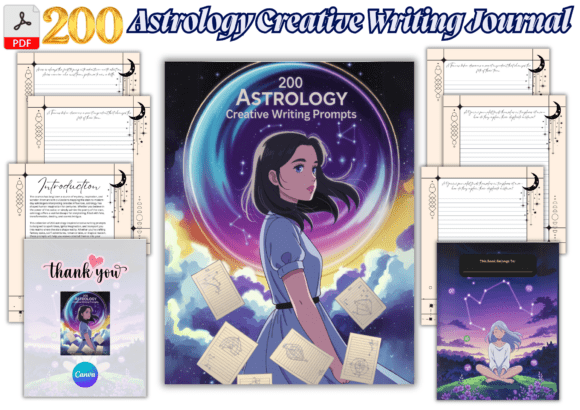
If you’ve ever stared at a blank page wondering how to channel wonder, depth, or emotional resonance into your writing—without forcing it—the Astrology Creative Writing Journal isn’t just another themed notebook. It’s a thoughtfully structured bridge between celestial patterns and human expression. Designed for writers, poets, journalers, educators, and content creators alike, this 8.5 x 11-inch PDF journal offers 200 original prompts rooted in zodiac archetypes, planetary transits, lunar phases, retrogrades, and mythic astrology—not horoscope clichés. Its strength lies in specificity: each prompt invites reflection, narrative exploration, or poetic experimentation grounded in real astrological symbolism—not vague “write about your feelings” directives.
What People Often Misunderstand (and Why It Matters)
Many assume an Astrology Creative Writing Journal is only for astrology beginners—or only for seasoned practitioners. Neither is true. Beginners may overlook how much context the journal provides: it doesn’t assume prior knowledge of aspects or house systems, but it also avoids oversimplifying Scorpio as “intense” or Gemini as “chatty.” Instead, prompts like *“Write a letter from Pluto to a character who’s just emerged from a long silence”* or *“Describe a city where Mercury retrograde physically rewinds street signs—but only for those who notice”* invite layered thinking without requiring fluency in ephemerides.
Conversely, experienced astrologers sometimes skip the journal because they expect technical depth—and miss its utility as a creative calibration tool. One freelance writer told us she used it before drafting client emails: “It helped me shift out of analytical mode and reconnect with voice, tone, and metaphor—especially during stressful Saturn transits when my writing felt rigid.” That’s not fluff—it’s functional neurodiversity-aware design.
Common Pitfalls—and How to Avoid Them
Assuming digital = automatic convenience. The journal comes as a high-resolution PDF with a Canva link—but that doesn’t mean it’s plug-and-play on every device. Some users download it to phones or tablets with older PDF viewers and find text formatting distorted or hyperlinks inactive. Better approach: Open the file first on a desktop using Adobe Acrobat or Chrome (which renders embedded links reliably), then test printing one page before committing to full-size paper. If you plan to use it digitally, check whether your note-taking app (like GoodNotes or Notability) supports clickable links and layer editing—some don’t.
Overlooking the physical format’s purpose. At 8.5 x 11 inches, this isn’t sized for portability—it’s designed for spacious handwriting, sketching alongside prompts, or laying open flat on a desk. Trying to shrink it to fit a pocket notebook defeats its intention. One educator printed it double-sided on matte cardstock, bound it with coil binding, and uses it in her creative writing workshops—students appreciate the room to write freely without cramped margins. If you prefer compact journaling, consider selecting only 30–40 prompts per month and transferring them manually into your preferred smaller notebook.
Misjudging customization scope. The included Canva link lets you change fonts, colors, and add logos—but it won’t let you rewrite prompts or restructure sections. You can’t convert it into a fill-in-the-blank workbook or add audio notes. That’s intentional: the prompts are curated sequences, not modular blocks. If you need heavy adaptation (e.g., aligning prompts to curriculum standards or adding rubrics), treat the Canva file as a starting point—not a blank canvas. Export editable text separately, then rebuild layouts in tools like Google Docs or Affinity Publisher where granular control matters more.
What to Verify Before You Download or Print
- Printer compatibility: Check your printer’s maximum paper size and margin settings. Some home printers auto-add 0.25-inch margins—cutting off headers or footers. Preview in “Actual Size” mode, not “Fit to Page.”
- PDF version: Ensure your PDF reader supports interactive elements. Older versions of Apple Preview may not activate the Canva link. When in doubt, click the link on desktop first and save the Canva project to your own account immediately.
- Intended use case: Ask yourself: Will I use this for daily micro-journaling? Workshop handouts? Client-facing creative coaching? If it’s for teaching, confirm the license permits classroom distribution (it does—no attribution required). If it’s for resale as part of a bundle, verify Canva’s commercial terms apply to your region.
- Time investment vs. return: Don’t feel pressured to complete all 200 prompts. One poet used just seven over six weeks—each tied to a new moon in a different sign—and turned them into a chapbook. Depth beats volume every time.
Why This Stands Apart From Generic Prompt Collections
Most writing prompt journals recycle tropes: “describe your dream home,” “write about loss,” “invent a character.” The Astrology Creative Writing Journal grounds abstraction in observable, cyclical phenomena. A prompt tied to Jupiter in Pisces doesn’t ask you to “write about hope”—it asks you to *“Draft a public service announcement broadcast from a lighthouse whose light only appears during fog—and only when someone is actively searching for direction.”* That’s not astrology as decoration. It’s astrology as scaffolding for precision, surprise, and emotional authenticity.
For freelancers building personal brands, it doubles as subtle positioning: using these prompts in newsletters or social posts signals depth and curiosity—not just trend-chasing. For small business owners launching creative courses, the editable Canva file means consistent branding across handouts, slides, and worksheets—no mismatched fonts or color shifts.
You don’t need to believe in destiny to benefit from structure rooted in rhythm. Planets move predictably. Seasons turn. Human stories thrive within constraint—and this journal gives you just enough cosmic framework to write with clarity, courage, and quiet confidence.