Arabic Writing Workbook for French Kids
For KDP publishers, educators, and language resource creators targeting French-speaking families or learners, the Arabic Writing Workbook for French Kids stands out as a purpose-built interior file—not just another workbook template, but a cohesive, pedagogically grounded tool designed specifically for early Arabic literacy development among French-speaking children and beginners.
A Structured Path Through the Arabic Script
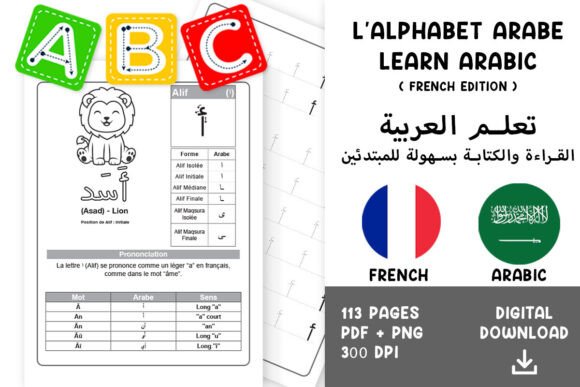
The workbook’s core strength lies in its systematic approach to Arabic letter formation. It covers all 28 letters across their four contextual forms—isolated, initial, medial, and final—with dedicated practice space for each. Unlike generic Arabic tracing sheets that assume prior script familiarity, this interior scaffolds learning: students first observe letter shapes, then trace, then write independently—all while receiving visual reinforcement through consistent, clean typography.
This progression aligns with best practices in second-language writing instruction, particularly for young learners whose fine motor skills and orthographic awareness are still developing. The layout avoids cognitive overload: one letter per page (or two at most), ample white space, and clear directional arrows guide stroke order without crowding the page.
Design That Supports Learning—Not Just Decoration
The inclusion of animal illustrations isn’t merely decorative—it serves functional pedagogy. Each letter is paired with a French-named animal whose name begins with that Arabic sound (e.g., éléphant for ا, girafe for ج). These visuals provide memory anchors and encourage cross-linguistic association, helping learners connect abstract symbols to concrete meaning. Crucially, the line art is thick, simple, and coloring-friendly—ideal for pencil or crayon use without bleeding or detail frustration.
Review pages appear every 5–7 letters and integrate real-life vocabulary: common nouns like porte, lampe, or table, written fully in Arabic script with French glosses. This bridges isolated letter practice to word-level recognition—a subtle but important step often missing in beginner workbooks.
Fully Bilingual, Fully Functional
Every instruction, prompt, and label appears in French only—no English or Arabic transliteration intrusions. This consistency eliminates translation friction for the target audience and reinforces language immersion. For example, “Trace la lettre” appears above guided lines; “Écris la lettre trois fois” follows; “Colorie l’animal” closes the activity. This level of linguistic alignment signals thoughtful audience research—not just translation, but adaptation.
That said, the interior does not include audio support, digital interactivity, or teacher guides. It is strictly a print-ready, self-contained worksheet collection—ideal for independent practice, homeschooling, or supplemental classroom use, but not a standalone curriculum.
Production Quality and KDP Practicality
At 113 pages, the interior balances depth with usability. It’s long enough to justify pricing tiers on KDP (especially when bundled with complementary titles), yet concise enough to avoid filler. All pages are formatted at standard US Letter (8.5" × 11") with 0.5" margins, bleed-free, and CMYK-ready—no last-minute layout adjustments needed before upload. Fonts are embedded, vectors are crisp, and grayscale compatibility is built-in (critical for cost-effective black-and-white printing).
The design uses a restrained color palette—primarily black text with occasional soft blue or green accents—ensuring readability and printer-friendliness. There are no watermarks, promotional banners, or placeholder text. What you see is what goes live: a clean, professional, market-aligned interior.
Who Benefits—and How
Publishers building niche educational catalogs will find this interior especially valuable. French remains one of the top five languages taught globally, with strong demand in Canada, Belgium, Switzerland, parts of Africa, and international schools. Arabic ranks among the most-requested world languages—but high-quality, age-appropriate French-Arabic resources remain scarce on KDP. This workbook fills that gap with zero content creation overhead.
Homeschooling parents and tutors appreciate its clarity and lack of ambiguity. A child can open the book and begin working without adult interpretation—thanks to intuitive French instructions and visual modeling. One educator in Montreal reported using it alongside free online Arabic pronunciation tools, assigning three pages per week with verbal reinforcement of sounds.
Small language schools and after-school programs have repurposed select sections as reproducible handouts—particularly the review pages and alphabet charts—because the PDF permits classroom use under standard KDP terms (provided the final product is sold, not distributed freely).
Realistic Considerations and Limitations
This is not a conversational Arabic course. It does not teach grammar, verbs, or sentence structure. Its scope is narrowly focused: handwriting, letter recognition, and foundational script literacy. Users expecting phonics explanations, dialect notes, or cultural context will need to supplement elsewhere.
While the animal associations aid recall, some pairings rely on Modern Standard Arabic pronunciation rather than colloquial variants—a reasonable choice for literacy-first goals, but worth noting for instructors serving North African or Levantine communities where pronunciation differs.
The workbook assumes basic French literacy in the learner (or supervising adult). It is not suitable for absolute beginners in French, nor for very young pre-readers without guidance—even with illustrations, instructions require reading comprehension.
Integration Into Broader Projects
Many successful KDP sellers use this interior as a foundation for tiered offerings: a low-cost “Arabic Alphabet Starter” (first 28 pages), a mid-tier “Complete Writing Workbook”, and a premium bundle with flashcards or a companion reader. Because the design is modular and thematically unified, these extensions feel cohesive—not pieced together.
For creators developing companion materials, the consistent visual language (same font family, spacing rhythm, illustration style) makes matching covers and supplementary PDFs straightforward. One publisher in Lyon extended the animal theme into a set of printable flashcards, using the same line art and French labels—resulting in a unified brand aesthetic across products.
Final Assessment
The Arabic Writing Workbook for French Kids delivers what it promises: a professionally structured, print-ready, pedagogically sound interior tailored to a specific, underserved audience. Its value isn’t in novelty, but in execution—consistent formatting, intentional bilingual framing, and attention to developmental appropriateness.
It won’t replace a qualified instructor or immersive environment—but for parents seeking accessible practice tools, publishers expanding into language education, or creators building scalable KDP assets, it offers reliable utility, minimal revision effort, and clear audience fit. In a marketplace crowded with generic worksheets, its specificity is its strongest asset.