Digital 2026 ADHD Brain Dump Template
If your mind feels like a browser with 47 tabs open—and three are playing audio—you’re not alone. The Digital 2026 ADHD Brain Dump Template is built for exactly that kind of mental chaos. It’s not another rigid planner demanding perfection. Instead, it’s a gentle, flexible, neurodivergent-friendly digital workbook designed to help you move thoughts out of your head and into a safe, organized space—without guilt, pressure, or complicated systems.
What This Planner Actually Does (No Jargon, Just Clarity)
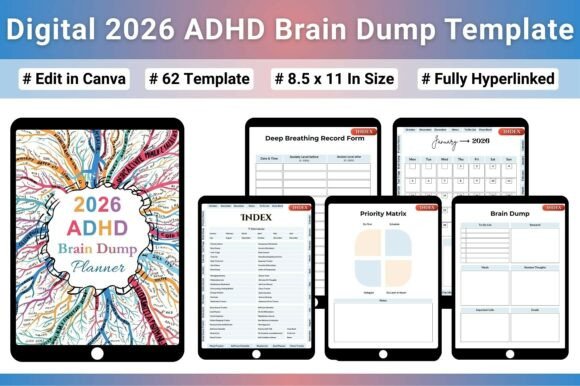
At its core, the Digital 2026 ADHD Brain Dump Template gives you structured breathing room. Think of it as a “mental offload tool” with intention behind every page. It includes daily brain dump sheets where you can scribble everything—from “call vet about Luna’s meds” to “why did I Google ‘can squirrels cry’ at 2:17 a.m.?”—without judgment. There’s also a Master Brain Dump for big-picture clutter, a Thought Parking Lot for ideas that aren’t urgent but shouldn’t vanish, and Overwhelm Reset pages that guide you through grounding questions when everything feels too loud.
The 62-page PDF is sized for US Letter (8.5×11 in), so it prints cleanly—or works beautifully on tablets with a stylus. And because it’s undated, you can start anytime. Missed January? Jump in February. Took a break in April? No reset required. That flexibility isn’t an afterthought—it’s central to how this template supports sustained use, especially for adults with ADHD who thrive on low-friction routines.
Why It Fits Real Life—Not Just Idealized Productivity
This isn’t about doing more. It’s about feeling less scattered while doing what matters—to you. A freelance graphic designer used the Daily Brain Dump to capture client feedback mid-call, then transferred only the actionable items to her task breakdown worksheet. A homeschooling parent used the Year-at-a-Glance page to map school breaks, therapy appointments, and sensory downtime—all in one glance—without needing color-coded spreadsheets.
Small business owners appreciate the Priority & Task Breakdown section: instead of staring at a long to-do list, they break one big goal (“launch new website”) into tiny, concrete steps (“find font pairings,” “draft homepage headline,” “test mobile menu”). Each step fits comfortably on a single line—no overwhelm, no paralysis.
Even educators and content creators find value—not as a lesson planner, but as a personal clarity tool. One blogger shared how the “Mental Clutter Release” page helped her separate creative ideas from self-criticism before drafting. Another used the Notes & Flexible Planning space to brainstorm podcast episode themes *and* jot down grocery reminders—on the same page—because her brain doesn’t compartmentalize neatly. And that’s okay.
Where It Works Best (And Where It Might Not)
This digital planner shines in low-stakes, high-impact moments: first thing in the morning, right after a meeting, during a transition between tasks, or even before bed if racing thoughts keep you up. You don’t need special software—just a PDF reader and a willingness to write freely. Many users annotate directly on their iPad or print single pages as needed.
It’s intentionally minimal. There are no habit trackers, no monthly reflection prompts that require 20 minutes of journaling, and no complex indexing system. If you love detailed analytics or automated reminders, this won’t replace your digital calendar—but it *complements* it beautifully. Think of it as your mental “inbox”: a place to land thoughts so your calendar, email, and project tools can stay focused on action—not storage.
Things to Keep in Mind Before You Begin
- You don’t have to fill every page. Some days, just writing “I’m tired and that’s enough” on a Brain Dump sheet counts as success.
- Consistency > completion. Using one page two times a week builds more neural trust than forcing yourself through 30 pages and quitting by March.
- It works best when paired with movement. Try standing while brain dumping, or walking around your home while speaking thoughts aloud and typing them in. Physical motion helps many ADHD brains process faster.
- Start small—even smaller than you think. Open the PDF. Scroll to the first Daily Brain Dump. Set a timer for 90 seconds. Write anything. That’s it. No review, no editing, no follow-up. Just release.
Who Benefits Most From This Approach?
The Digital 2026 ADHD Brain Dump Template was created with neurodivergent minds in mind—but its calm structure resonates widely. Busy creatives love the open layouts that leave room for doodles and tangents. Entrepreneurs appreciate how the “Get It Out of My Head” sheets reduce decision fatigue before strategy sessions. Educators use the Monthly Planning pages to block time for grading *and* rest—without pretending both require equal mental energy.
It’s also a quiet act of self-respect. When your brain generates ideas, worries, to-dos, and memories all at once, treating each thought as equally urgent leads to burnout. This template helps you triage gently—not with harsh filters, but with compassionate pauses. That “Thought Parking Lot”? It says, “This idea matters, but not right now.” That “Overwhelm Reset”? It whispers, “You’re allowed to stop and breathe before choosing what comes next.”
A Tool That Grows With You
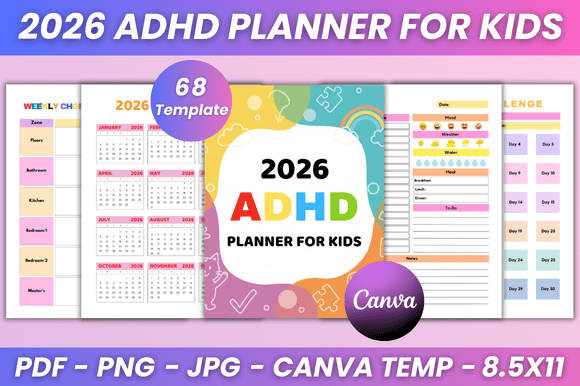
Unlike static planners that assume one-size-fits-all, this workbook adapts. Use the full 2026 calendar to mark deadlines—or ignore dates entirely and treat it as a rolling clarity journal. Print the Master Brain Dump when your head feels full. Skip to the Priority Worksheet when launching a new project. Bookmark the Mental Clutter Release page for tough emotional days.
There’s no “right way” to use the Digital 2026 ADHD Brain Dump Template. There’s only your way—today. And tomorrow. And the day after, when your needs shift again. That’s not a flaw in the design. It’s the point.