New Year Resolutions Book Template
A well-structured New Year Resolutions Book Template isn’t just a notebook—it’s a functional bridge between intention and action. Designed for clarity, consistency, and real-world use, this template supports adults who treat goal-setting as a repeatable process—not a once-a-year ritual. Whether you’re launching a side hustle, refining personal habits, managing team objectives, or building content systems, the right template anchors your planning in structure without sacrificing flexibility.
This particular New Year Resolutions Book Template is built for Amazon KDP creators and users who value precision, compliance, and speed. It arrives as a ready-to-upload PDF—6 x 9 inches, 300 PPI, KDP-tested, and fully compatible with Amazon’s interior requirements. No reformatting. No guesswork. Just upload, preview, and publish.
How It Fits Into Real Planning Workflows
Resolutions don’t exist in isolation. They emerge from reflection, feed into scheduling, inform budgeting, and evolve through review. This template integrates cleanly at multiple points: before a goal is formalized (to clarify scope and criteria), during execution (to track progress and adjust tactics), and after completion (to extract insights for next-cycle planning).
For example, a freelance graphic designer might use the first section to define a resolution like “Land three retainer clients by Q2.” The weekly budget log pages then allow them to record outreach efforts, proposal time, follow-up dates, and associated costs—linking behavioral output directly to financial and timeline outcomes. An educator could adapt the same framework to plan curriculum upgrades, mapping quarterly milestones alongside resource allocation and student feedback windows.
The template doesn’t replace calendars or project tools—it complements them. You’ll still use Google Calendar for deadlines and Notion for task breakdowns, but this book becomes the single source of truth for *why* those deadlines matter and *how* they connect to broader annual intent.
Design That Supports Consistency—Not Clutter
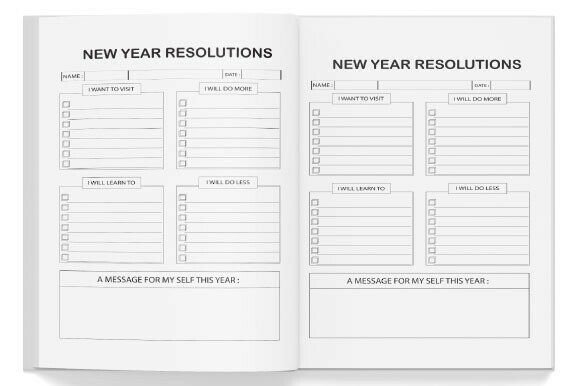
Every page serves a defined role. The intro page sets tone and purpose—not filler, not branding fluff, but a concise prompt that invites honest self-assessment. The weekly budget log pages include dedicated lines for income, fixed expenses, variable spending, and reflection notes—not just columns to fill, but cues to pause and evaluate trade-offs.
The full interior is 100% unique: no stock layouts, no recycled KDP templates. Each element—from margin spacing to line height to checkbox sizing—was tested against KDP’s print preview system to avoid cutoffs, bleed issues, or alignment errors. That means fewer revision rounds, faster time-to-market, and higher reader trust in the final product.
It’s also designed for dual use: as a physical planner *and* a digital asset. The included EPS, PNG, JPEG, and PDF files let you repurpose visuals for social media, email sequences, or sales pages—without licensing friction or pixelation. That versatility matters if you’re building a KDP catalog, running a productivity-focused newsletter, or offering bundled resources to coaching clients.
Practical Implementation Tips for Creators and Users
For KDP Publishers: Upload the PDF exactly as provided—no resizing, no compression, no font embedding overrides. The file meets KDP’s 300 PPI requirement and uses CMYK-safe colors for accurate print reproduction. Test the preview using KDP’s online tool before approving; you’ll see crisp text, consistent margins, and properly spaced lines across all 100+ pages.
For End Users: Start with the intro page—but don’t rush it. Spend 10 focused minutes answering the prompts: What would make this year meaningfully different? Which resolutions align with energy—not just ambition? Where have past attempts stalled, and what support would change that? That grounding step transforms the rest of the book from a tracking tool into a decision-support system.
Use the weekly budget log pages not just to record numbers, but to spot patterns. If “marketing spend” consistently exceeds projections while “client onboarding time” stays low, that signals a mismatch between acquisition strategy and capacity planning. The template surfaces those tensions early—so adjustments happen in week three, not week thirty.
Compatibility and Integration With Other Systems
This New Year Resolutions Book Template works alongside common tools—not against them. Pair it with time-tracking apps like Toggl or Clockify to correlate logged hours with weekly goals. Import expense data from QuickBooks or Wave into the budget sections for accuracy. Use the blank reflection lines to summarize key takeaways before adding them to your Notion dashboard or weekly team sync.
For educators or trainers, the structure supports cohort-based learning: assign one resolution per module, use the weekly logs for accountability check-ins, and collect anonymized reflections to refine future curriculum. For solopreneurs, it replaces fragmented spreadsheets and sticky-note systems with a unified format that scales with workload—no extra setup required.
Because it’s built for KDP, it also integrates smoothly into existing catalogs. Bundle it with habit trackers, quarterly planners, or finance workbooks—readers recognize the consistent design language, clean typography, and intentional spacing. That cohesion builds brand recognition over time, especially when each interior follows the same quality bar: tested, compliant, and human-centered.
Long-Term Use Without Friction
Many planners fail not at launch—but at month four. Pages get skipped. Sections feel irrelevant. Motivation dips, and the book gathers dust. This template avoids that by building in natural reset points: the weekly format prevents overwhelm, the budget log ties abstract goals to tangible inputs, and the reflection prompts are open-ended enough to stay useful whether you’re reviewing day seven or day 287.
It also supports iteration. You don’t need to start over each January. Flip to the back, note what worked and what didn’t, then carry forward only the structures that earned their place. That kind of sustainability—where the tool evolves with the user—is rare in off-the-shelf planning resources.
And because it’s delivered as multiple file types (EPS for vector edits, PNG/JPEG for web previews, PDF for print), you can adapt it without starting from scratch. Add your logo to the cover. Insert custom instructions for a corporate training version. Convert select pages into Canva templates for client onboarding. The foundation stays solid—the application stays flexible.
Why This Version Stands Out in a Crowded Space
Most New Year Resolutions Book Templates fall into two categories: overly rigid (with prescriptive daily checkboxes) or too vague (just blank pages with a title). This version occupies the middle ground—structured enough to guide focus, open enough to accommodate complexity.
It’s not built for perfection. It’s built for momentum. The weekly budget log doesn’t assume you’ll track every coffee purchase—it assumes you’ll notice when recurring expenses shift your runway. The resolution pages don’t demand SMART goals upfront—they invite clarity through iterative writing, with space to revise, cross out, and expand.
If you’re publishing on KDP, that balance translates directly to reviews and repeat buyers. Readers comment on usability, not aesthetics alone. They return for interiors that feel like collaborators—not decorations. And they recommend products that help them act, not just aspire.
So whether you’re preparing your first KDP upload or expanding a proven catalog, this New Year Resolutions Book Template delivers what matters most: reliability in execution, clarity in design, and room for growth—on the page and beyond.