Storytime Fun Puzzles
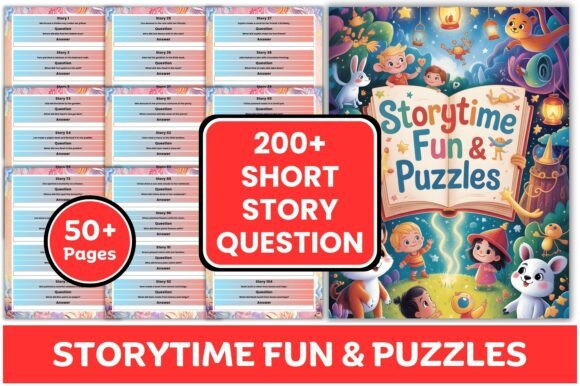
If you're looking for a way to turn daily reading into something your child eagerly anticipates—not just tolerates—you’ll want to pay close attention to Storytime Fun Puzzles. It’s not another flashcard deck or worksheet bundle. It’s a thoughtfully designed activity book that pairs bite-sized, age-appropriate stories with simple, open-ended questions—transforming passive listening or independent reading into active thinking, recall, and joyful engagement.
What makes it stand out isn’t novelty for novelty’s sake. It’s how well it aligns with how young brains actually learn: through repetition, interaction, and low-stakes challenge. Each of the 200 mini stories is written for preschoolers and early kindergarteners—short enough to hold attention, rich enough in language to build vocabulary, and grounded in familiar themes like animals, seasons, friendship, and routines. The follow-up question isn’t a quiz—it’s an invitation: “What did the squirrel forget?” or “Why do you think she smiled?” That subtle shift—from testing to prompting—makes all the difference in building comprehension confidence.
Common Missteps When Choosing or Using Storytime Fun Puzzles
Even well-intentioned adults sometimes miss key details that affect how well Storytime Fun Puzzles works in real life. Here’s what often goes overlooked—and why it matters.
Assuming “simple” means “too easy”
Some parents and teachers skim the sample pages and assume the short sentences and clear illustrations mean the content lacks depth. But simplicity here is intentional scaffolding—not dilution. The stories use controlled vocabulary, predictable patterns, and repeated sentence structures—all evidence-based supports for emerging readers. Skipping ahead to more complex material too soon can actually undermine fluency and confidence. Instead, use the first 20–30 puzzles consistently—even if they seem basic. Watch how your child begins to anticipate story endings, infer feelings, and connect ideas across pages.
Printing without checking layout compatibility
The interior is formatted for standard 8.5 × 11 paper—but not all printers handle margin settings the same way. If you print without selecting “Fit” or “Shrink oversized pages” in your PDF viewer, you risk cutting off answer lines or story text. A quick test print of page 3 (which includes both narrative and response space) saves time and ink. Also, avoid printing double-sided by default unless you’ve confirmed the back side won’t bleed through—the clean layout relies on legible handwriting space, and ghosting from the reverse side can make responses hard to read.
Treating it as “just another workbook”
Storytime Fun Puzzles shines brightest when used interactively—not as silent seatwork. One common misstep is handing it to a child with instructions like “Do five pages before lunch.” That misses the core design: these are conversation starters. Better? Read the story aloud together, pause after the question, and talk it through—even if the answer seems obvious. Ask, “How do you know?” or “What part of the story tells us that?” That builds metacognition, not just answers.
Overlooking the classroom flexibility
Teachers sometimes reserve it for “fast finishers” or quiet time—but its real power lies in small-group literacy centers. Because each puzzle is self-contained (story + question + writing space), it works seamlessly for differentiated instruction. You might assign one story to a group focusing on sequencing, another to a group practicing character emotions, and a third to students building inference skills—all from the same book. No prep needed beyond choosing the focus. Just keep a timer nearby: three minutes per story is usually enough to read, discuss, and write one sentence.
What to Check Before You Download or Print
Before committing time or resources, verify these practical points:
- PDF integrity: Open the file on your device—not just your phone’s preview app. Some mobile PDF viewers compress images or hide fonts, making text blurry or spacing inconsistent. If the answer lines look cramped or the font renders oddly, download the full version using Adobe Acrobat or Preview.
- Printer readiness: Confirm your printer handles 8.5 × 11 without auto-scaling. Try printing page 1 at 100% scale first. If the margins shrink or expand unexpectedly, adjust your printer’s “Page Scaling” setting to “None” or “Actual Size.”
- Usage context: Are you planning to use this at home, in a classroom, or for homeschool co-ops? If multiple children will share copies, consider laminating pages and using dry-erase markers instead of printing dozens of sets. The clean layout holds up well to lamination—and lets kids revise answers without erasing.
- Alignment with goals: Ask yourself: Do I need reinforcement for decoding? Comprehension? Oral language? Writing stamina? Storytime Fun Puzzles excels most in the middle two—especially when paired with verbal discussion first, then written response. If phonics practice is your top priority, pair it with decodable readers—not instead of them.
A Smarter Way to Start
Instead of diving into page 1 and working straight through, try this approach for stronger results:
- Select 3–5 puzzles that match your child’s current interests—a story about dogs, baking, or bedtime—then read those first. Familiar topics increase engagement and reduce cognitive load.
- Model the thinking process aloud: “Hmm, the story says the cat hid under the table. So my answer could be ‘because she was scared.’ But wait—what else happened right before? Oh! The balloon popped. That helps me explain why.”
- Keep responses low-pressure: Accept drawings, single words, or dictated sentences. The goal is connection—not perfect spelling. Over time, children naturally begin adding more detail on their own.
Remember: Storytime Fun Puzzles isn’t about filling pages. It’s about building the quiet, steady habits that turn reluctant readers into curious thinkers. When a child pauses mid-story to ask, “What do you think happens next?”—that’s the moment the puzzle has done its work. And that’s worth far more than any completed worksheet.
Whether you’re a parent carving out ten calm minutes before school, a teacher rotating literacy stations, or a homeschooler seeking meaningful screen-free practice—this book meets kids where they are. Not with pressure. Not with complexity. But with stories that listen back, and questions that invite them to speak up.