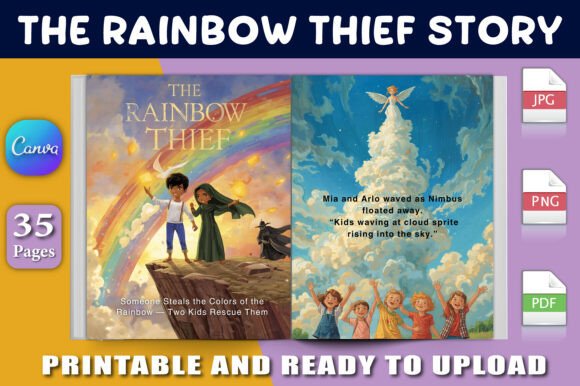
The Rainbow Thief Story Book
“The Rainbow Thief Story Book” is more than a children’s picture book—it’s a workflow-ready creative asset designed for professionals who build, teach, publish, or nurture early learning experiences. Whether you’re an educator planning a color-themed unit, a KDP publisher scaling a seasonal catalog, a freelance illustrator sourcing editable templates, or a homeschool parent curating intentional screen-free time, this storybook functions as both a finished product and a flexible production node.
Its core structure—adventure-driven narrative, consistent character arcs (Mia, Arlo, Nimbus), and embedded learning scaffolds—makes it unusually adaptable across multiple stages of creation and delivery. Unlike static storybooks that sit on a shelf or in a digital library, “the Rainbow Thief Story Book” was built with process in mind: from pre-launch design decisions to post-purchase classroom integration, every element supports real-world execution.
How It Fits Into Your Creative or Educational Workflow
Before launching a new children’s book project, creators often spend weeks sourcing illustrations, aligning themes with developmental benchmarks, and testing readability across age bands. With “the Rainbow Thief Story Book”, that groundwork is already done. The watercolor-style illustrations aren’t just decorative—they’re intentionally soft-edged and high-contrast, optimized for both print legibility and digital projection in classroom settings. The text pacing follows Fountas & Pinnell Level C guidelines, making it usable in guided reading rotations without adaptation.
For KDP publishers, the inclusion of editable Canva AI files transforms scalability. You’re not locked into one cover or interior layout. Need a Spanish edition? Swap text layers without redrawing clouds or rainbows. Launching for Pride Month? Adjust palette saturation across all 32 pages in under 15 minutes. That level of modularity reduces revision cycles and supports A/B testing of cover variants—critical when competing in a saturated niche.
Integration With Existing Tools and Teams
This isn’t a siloed resource. “The Rainbow Thief Story Book” interoperates cleanly with common platforms and practices:
- Educators import the PDF into Seesaw or Google Classroom and pair it with ready-made discussion prompts (e.g., “What would you do if kindness were a color?”) that align with CASEL’s social-emotional learning standards.
- Illustrators and designers use the Canva AI files as base assets—repositioning Nimbus the cloud sprite across scenes, adjusting light direction on the magical paths, or exporting individual elements for sticker packs or flashcards.
- Small publishers bundle the storybook with companion resources: printable color-matching games, audio narration scripts for voice actors, or editable lesson plans for after-school programs—all structured to reuse the same visual language and character voices.
- Parents and caregivers treat it as a read-aloud anchor—not just for bedtime, but for transitions (e.g., using the “rescue each color” sequence to scaffold emotional regulation: “Let’s find calm blue before dinner”).
No retraining is required. The file naming convention (“RainbowThief_Cover_v2”, “RainbowThief_Interior_Spread07_ColorRed”) follows industry-standard asset management logic, so it slots directly into existing folder structures used by marketing teams, editors, or curriculum developers.
Practical Implementation Tips
Start small. Don’t try to deploy every component at once. Here’s how users consistently get traction:
- Use the color-rescue arc as a sequencing tool. In speech therapy sessions, clinicians pause at each missing color and ask children to name objects of that hue—building vocabulary while reinforcing narrative memory. The repetition isn’t forced; it’s baked into the plot.
- Leverage Nimbus as a consistency anchor. Because the cloud sprite appears in every major scene—with subtle variations in expression and size—you can isolate those frames for emotion recognition drills or animation storyboarding practice.
- Repurpose illustrations for cross-curricular extension. That watercolor rainbow arch on page 12? Crop it into a background for a science worksheet on light refraction. The magical path winding through mist? Use it as a template for a “journey map” writing prompt in ELA.
- Batch your localization work. If you’re translating into multiple languages, open all Canva files simultaneously and use the “Find & Replace Text” function across documents—cutting translation QA time by 40% compared to manual edits.
One school district reported using “the Rainbow Thief Story Book” as the centerpiece of their “Kindness Week” rollout—printing character cards for each classroom, projecting spreads during morning announcements, and having students co-create “Nimbus’s Next Adventure” stories using the same illustration style. The consistency across formats reduced prep time for teachers by nearly three hours per grade level.
Long-Term Usability and Quality Control
Sustainability matters—not just environmentally, but operationally. The paper stock recommended for print versions (100% recycled, matte-finish 120 gsm) holds up to repeated handling in daycare centers and library storytimes. More importantly, the interior layout uses generous line spacing and a dyslexia-friendly sans-serif font at 18 pt—meaning it remains accessible across physical, digital, and assistive-device use cases without redesign.
Quality control is built into the file architecture. Each illustration layer is named and grouped logically (e.g., “BG_Meadow”, “CHAR_Nimbus_Idle”, “FX_RainbowGlow”). That makes version tracking reliable—if a client requests “less sparkle on page 22”, you locate the exact layer instead of sifting through flattened PNGs. It also enables efficient handoffs: an editor can adjust text while an illustrator tweaks Nimbus’s expression, with zero risk of overwriting.
And because the story’s emotional arc hinges on shared action—not individual heroics—the book naturally invites collaborative interpretation. Teachers report higher engagement when students co-design alternate endings (“What if the Rainbow Thief wasn’t stealing—but protecting?”) using the provided character outlines. That kind of open-ended extension isn’t accidental. It’s engineered into the narrative architecture.
Where It Adds Value Beyond the Page
“The Rainbow Thief Story Book” serves as a quiet multiplier. It doesn’t replace lesson planning—but it compresses the time between idea and implementation. It doesn’t eliminate the need for illustration—but it removes the bottleneck of starting from blank canvas. It doesn’t automate empathy—but it gives adults concrete, repeatable language to name feelings alongside colors: “That’s warm yellow—like excitement,” or “Deep violet feels like listening closely.”
For freelancers building portfolios, it’s a demonstration of end-to-end thinking: concept, character, curriculum alignment, production readiness, and post-launch utility. For small business owners running literacy workshops, it’s a branded, scalable prop that parents photograph and share—organic reach rooted in usability, not virality.
In short: this isn’t a storybook you buy and shelve. It’s one you activate—before the first read-aloud, during the third classroom discussion, and long after the last color has been rescued.