Why the Customized 2026 Business Workbook Is the Strategic Tool Your Business Needs This Year
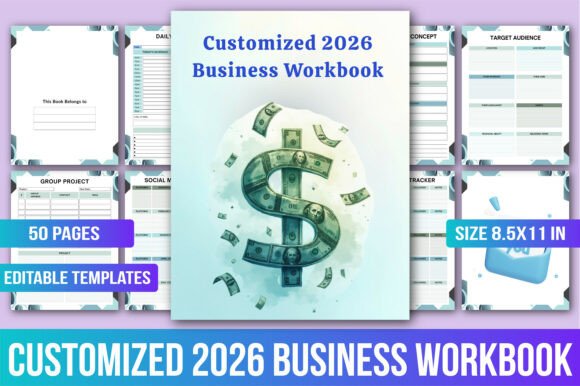
Running a business—whether you're launching your first side hustle, scaling a small team, or refining a creative studio—requires more than passion and ideas. It demands structure, intentionality, and consistent reflection. That’s where the Customized 2026 Business Workbook steps in: not as another generic planner, but as a purpose-built, holistic business operating system designed for real-world execution.
In an age of digital overload and fragmented tools—where notes live in Slack, deadlines hide in email, and goals drift across half-filled Notion pages—the value of a unified, tactile, and thoughtfully organized workbook has surged. This isn’t nostalgia for paper; it’s recognition that focused, uninterrupted planning leads to better decisions, clearer priorities, and measurable progress.
What Exactly Is the Customized 2026 Business Workbook?
The Customized 2026 Business Workbook is an all-in-one physical (and printable digital) planning companion engineered for entrepreneurs, solopreneurs, freelancers, small business owners, and mission-driven creators. Unlike calendars or journal-style planners, it merges strategic thinking with daily action—bridging the gap between long-term vision and tomorrow’s to-do list.
It’s built on the principle that business growth isn’t linear—it’s cyclical. You plan, launch, assess, adjust, and repeat. This workbook supports every phase: from validating your idea before spending a dime, to tracking social media engagement week over week, to reviewing quarterly performance with clarity—not confusion.
More Than Just a Planner—It’s a Business Framework
Think of it as your personal business architect. While many workbooks focus only on time management or goal setting, this one embeds foundational business disciplines directly into its layout:
- Strategic analysis — via SWOT and market competitor comparison sheets;
- Operational discipline — through startup checklists, vendor contact logs, and process documentation prompts;
- Tactical execution — with hourly daily planners, deadline trackers, and project progress bars;
- Growth mindset scaffolding — using quarterly goal reviews, core concept refinement pages, and customer reach strategy worksheets.
This integration matters. A founder who completes the Business Core Concept Pages early gains sharper messaging before designing a logo. Someone who uses the Quarterly Goals Planner alongside the Daily Planner avoids misalignment—like spending hours on Instagram posts while neglecting a critical client proposal due in 48 hours.
Key Features—And Why Each One Solves a Real Problem
Let’s break down how each section translates into tangible impact—and why “nice-to-have” features become non-negotiable when your time and energy are limited.
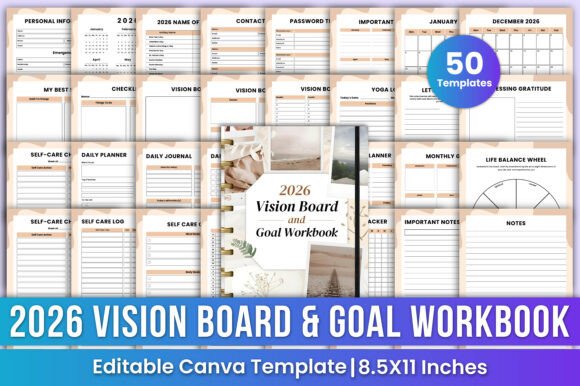
📅 Full-Year 2026 Calendar + Monthly Layouts
A clean, uncluttered calendar isn’t just about marking holidays. It’s your macro-view lens. Seeing Q1 tax deadlines, industry conferences, product launch windows, and seasonal marketing peaks across 12 months helps you spot capacity gaps *before* they become crises. Bonus: no syncing errors, no app updates breaking your flow.
📝 Daily Planner Pages (6 AM–8 PM)
This isn’t a blank grid. It’s a behaviorally informed schedule: realistic time blocks, space for top 3 daily goals, a dedicated “progress tracker” bar (not just a checkbox), and room for reflective notes. Research shows that writing down intentions—even briefly—increases follow-through by up to 42%. These pages turn intention into ritual.
📇 Contact List Organizer
How many times have you searched your inbox or scrolled through 200+ contacts for a vendor’s contract terms? This section standardizes how you capture and retrieve relationships—with fields for name, role, contact details, key notes (“sent proposal Jan 12”, “wants case study”), and even follow-up dates. It transforms scattered data into actionable intelligence.
🚀 Business Startup Checklist
Starting a business involves over 50 common tasks—from choosing a legal structure and opening a business bank account to drafting service agreements and setting up basic bookkeeping. This step-by-step guide groups actions by phase (Research → Legal → Branding → Launch), includes estimated timelines, and flags high-impact vs. low-urgency items. It prevents costly oversights—like forgetting EIN registration or misclassifying contractors.
🎯 Quarterly Goals Planner
Annual goals often fade by February. Quarterly planning combats that. Each quarter has its own spread: top 3 objectives, key metrics, success indicators, and space to record wins, pivots, and lessons. When used consistently, it builds organizational memory—and reveals patterns (e.g., “We always under-resource Q3 content planning”).
🔍 SWOT Analysis Template
SWOT isn’t just for MBA students. Used quarterly, it surfaces blind spots. Example: A local bakery might list “Strong community reputation” (Strength), “Limited online ordering capability” (Weakness), “Rising demand for meal kits” (Opportunity), and “New grocery delivery partnerships undercutting margins” (Threat). That insight directly informs R&D and tech investment decisions.
🧩 Business Core Concept Pages
This is where clarity begins. Instead of vague statements like “I help people,” users define: Exactly what problem do I solve? For whom? How is my solution different? What does success look like in Year 1? These pages force specificity—turning abstract visions into testable hypotheses.
Who Benefits Most—and Who Might Overlook Its Value?
While ideal for solopreneurs and teams under 5, the workbook also serves seasoned operators. A marketing agency owner told us she uses the Social Media Tracker to compare platform ROI across clients—spotting which channels drive actual conversions, not just likes. A nonprofit director repurposes the Market Competitor Sheet to benchmark peer organizations’ grant strategies.
Common misconception? “I’m too busy for planning.” In reality, those who skip structured reflection spend *more* time firefighting. The workbook reduces cognitive load: instead of remembering what to track, you simply open to the right page.
How It Fits Into Today’s Work Landscape
We live in a hybrid world—digital tools excel at automation and searchability; analog tools excel at focus and synthesis. The Customized 2026 Business Workbook doesn’t reject technology—it complements it. Use it to draft your content calendar, then export key dates to Google Calendar. Fill out the SWOT, then discuss insights in your next team meeting. Print the Startup Checklist, tick off items with a pen, and snap a photo to share with your accountant.
It also meets rising demand for intentional productivity—a shift away from hustle culture toward sustainable, values-aligned growth. When your planner asks, “What’s one thing I’ll stop doing this quarter to protect my energy?” it reframes success beyond revenue alone.
Getting Started—No Overwhelm Required
You don’t need to fill every page on January 1st. Start small:
- Complete the Business Core Concept Pages—takes 20 minutes, pays dividends for months.
- Block 15 minutes weekly to review the Daily Planner and update your Top Projects list.
- At quarter-end, use the Quarterly Goals Planner to reflect—not just report.
Consistency beats completeness. Even filling out 2–3 sections per week builds momentum, confidence, and business resilience.
The Customized 2026 Business Workbook isn’t about perfection. It’s about showing up for your business—systematically, compassionately, and strategically. In a year full of uncertainty, having one trusted place to think, plan, and act makes all the difference.