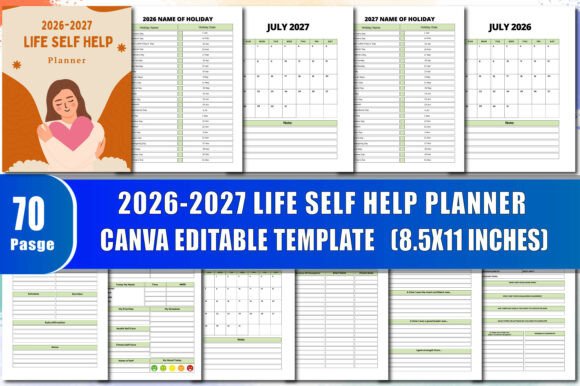
2026–2027 Life Self Help Planner: A Practical Tool for Intentional Living and Consistent Growth
Planning isn’t just about scheduling—it’s about aligning action with values, building resilience through reflection, and creating space for self-awareness in the midst of daily demands. The 2026–2027 Life Self Help Planner is designed not as a passive calendar or generic journal, but as an integrated workflow companion for adults who lead complex, multifaceted lives. Whether you’re launching a side project, managing team deliverables, navigating career transitions, supporting family needs, or rebuilding routines after burnout, this planner supports real-world execution—not just aspiration.
How It Fits Into Your Existing Workflow
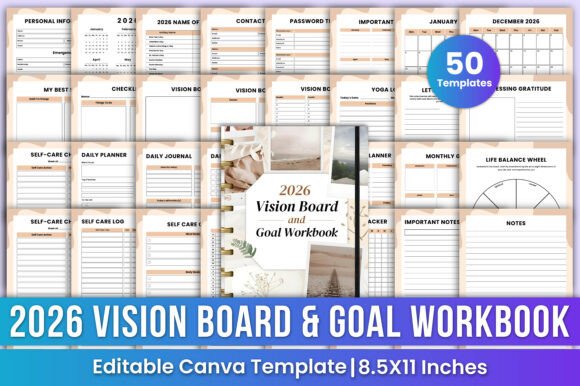
This isn’t a standalone artifact to sit on a shelf. It’s built to integrate—seamlessly—into how you already work. For freelancers, it replaces fragmented notes across apps by consolidating goal tracking, client follow-ups, energy mapping, and self-care accountability into one physical or printable system. Educators use the Coaching Log and Wheel of Life pages to reflect on teaching practices while modeling intentional habits for students. Entrepreneurs pair the Personal Crisis Plan and Stress Diary with quarterly business reviews to anticipate emotional friction points before they impact decision-making.
Because the interior is built for Canva, editing happens where you already spend time: designing social posts, drafting email sequences, or prepping presentations. You can adjust colors to match your brand palette, swap icons for visual consistency, or reformat text blocks to suit your reading rhythm—all without design expertise. That flexibility means the planner stays relevant across roles, seasons, and priorities.
Preparation, Not Perfection
Before jumping into January 2026, use the Belongs To Page and This Book Belongs To sections to ground ownership—not just of the tool, but of your commitment. Write your name, a personal intention (“I choose presence over productivity”), or even a boundary (“I will review this weekly, not daily”). This small act signals to your brain that this is *yours*, not another task to optimize.
The dual-year structure—spanning both 2026 and 2027—lets you plan ahead without losing sight of the present. Use the 2026 Calendar and 2027 Calendar pages alongside holiday lists to identify natural inflection points: quiet weeks after holidays for reflection, busier months for delegation, or seasonal energy shifts (e.g., lower motivation in late winter) to inform pacing. No need to force consistency—instead, build rhythms that respond to reality.
Real Integration, Not Isolation
Most planners fail because they exist in isolation from other systems. This one works *with* what you already use:
- With digital tools: Scan completed Daily Checklists or Gratitude Lists into note apps for long-term pattern tracking. Export Canva edits as PDFs to sync with cloud storage or share with accountability partners.
- With professional practice: Fill out the Mindfulness Journal before client calls to center focus. Log coaching conversations in the Coaching Log, then reference insights during performance reviews.
- With learning workflows: Pair the Activity Completion Record with online course enrollments—marking not just “finished,” but “applied in X context” or “needs revision.”
- With health routines: Cross-reference the Energy Drainers page with your fitness tracker data or sleep logs to spot correlations between physical state and mental output.
You don’t need to adopt every section at once. Start with two: one for grounding (Gratitude List or Positive Self-Talk) and one for action (Daily Checklist or Self Care Planner). Build outward only when those feel sustainable.
Design That Supports, Not Distracts
The Canva interior prioritizes usability over ornamentation. Clean typography, generous margins, and intuitive section spacing reduce cognitive load—especially important for users managing ADHD, chronic fatigue, or high-stakes responsibilities. Color isn’t decorative; it’s functional. Use warm tones for self-care sections and cooler palettes for planning or analysis. Shapes guide attention: circles for reflection prompts, arrows for progression tracking, checkboxes with enough space for handwritten notes—not rushed ticks.
Because it’s print-ready, you control paper weight, binding, and size. Print double-sided on recycled stock for sustainability. Staple a few key months for travel. Or go fully digital: annotate directly in PDF readers, add voice memos via linked apps, or export pages as image files for social media reflection prompts.
Long-Term Use Without Burnout
A planner’s value multiplies over time—but only if it adapts. The Confidence Log and Self-confidence Builder aren’t motivational filler. They’re evidence trackers. Review them quarterly: What situations consistently erode confidence? Where did growth happen quietly, outside formal goals? That data informs future planning—not just what to do next, but *how* to support yourself while doing it.
The Personal Crisis Plan is especially powerful when revisited—not during overwhelm, but during calm. Update contact lists, refine coping strategies, and test resource links every six months. Treat it like a fire drill: practiced, not performed.
Consistency comes from alignment, not discipline. If the My Stress Diary feels burdensome, switch to bullet-point entries or voice-to-text summaries. If the Wheel of Life feels abstract, anchor each segment to one measurable behavior (“Health = three 20-minute walks/week”). The planner doesn’t prescribe—it invites calibration.
From Planning to Publishing—Without Compromise
For creators preparing to publish on Amazon KDP, this planner delivers production-ready assets. All files are high-resolution, CMYK-optimized, and bleed-inclusive. The interior includes properly formatted title pages, copyright notices, and ISBN-ready placeholders. You’ll receive layered Canva files—editable text, grouped elements, and locked backgrounds—so updates stay efficient across editions.
That means you can launch fast, iterate based on reader feedback (e.g., adding a “Remote Work Balance” spread), and maintain brand integrity across formats—print, PDF, or even adapted digital courses. No outsourcing design. No licensing headaches. Just clarity, control, and continuity.
Final Thought: Tools Serve People, Not the Other Way Around
The 2026–2027 Life Self Help Planner succeeds not because it’s comprehensive, but because it’s contextual. It meets people where they are—in transition, in growth, in recovery—and gives them structure without rigidity, reflection without pressure, and intentionality without guilt. It doesn’t ask you to be more productive. It asks you to be more present—to your goals, your limits, your values, and your humanity.
Use it to map your year. Revise it when life interrupts. Revisit it when you forget why you started. That’s not inconsistency—that’s integration.