500 Mindful Gratitude Prompts
If you’ve ever flipped open a journal and felt stuck—not because you lack things to be grateful for, but because the noise of daily life drowns out your ability to notice them—you’re not alone. 500 Mindful Gratitude Prompts isn’t another checklist or productivity tool. It’s a quiet invitation: to pause, breathe, and meet yourself where you are—with kindness, curiosity, and zero pressure.
This collection lives in the thoughtful space between mindfulness practice and tangible, everyday ritual. Visually, it favors clean layouts, generous white space, and uncluttered typography—no ornate flourishes or distracting graphics. The tone is warm but never saccharine; grounded but never clinical. Think soft serif headings paired with highly legible, slightly rounded sans serif body text—designed not just to be read, but to be *felt* as you write. There’s intention behind every line break, every margin, every prompt’s pacing. It doesn’t shout. It settles in.
A Journal That Supports Your Rhythm—Not Overrides It
Unlike rigid planners or prescriptive habit trackers, 500 Mindful Gratitude Prompts meets people where they are. A designer sketching between client calls might land on a prompt like *“What small detail in today’s work environment brought unexpected calm?”* An entrepreneur reviewing quarterly metrics might pause at *“When did I extend grace to myself this week—even silently?”* A parent juggling school drop-offs and meal prep might connect with *“Name one ordinary sound you heard today that felt like home.”*
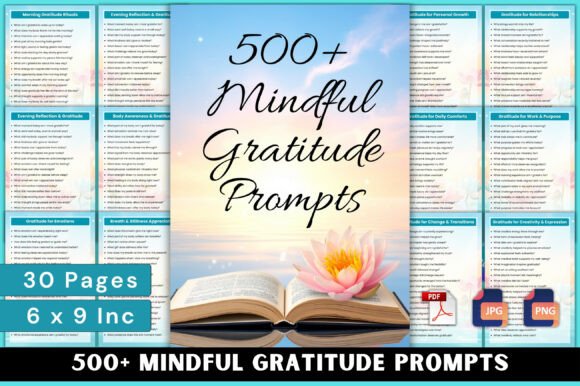
The prompts are grouped not by chronology, but by resonance: Present-Moment Gratitude, Self-Gratitude, Relationships, Nature & Simple Joys, Inner Strength & Acceptance. This structure mirrors how attention actually works—not linearly, but associatively. You don’t need to start on page one. You can open to any section, any prompt, and land somewhere meaningful. That flexibility makes it viable for real life—not just idealized routines.
Why Designers and Content Creators Reach for This Collection
Creative professionals know that consistency isn’t about repetition—it’s about coherence. When you’re building a brand identity, writing a newsletter, or designing a workshop workbook, tone and texture matter as much as color or layout. 500 Mindful Gratitude Prompts functions as both content source and subtle design reference. Its language models clarity without coldness, warmth without vagueness—qualities that translate directly into strong editorial design, empathetic UX copy, and authentic social media voice.
For marketers and publishers, it’s a rare asset: a ready-made library of emotionally intelligent, audience-resonant prompts that avoid cliché (“What are you thankful for?”) in favor of specificity (“What gesture—yours or someone else’s—carried more weight than words today?”). That specificity builds trust. Readers feel seen, not scanned.
How It Fits Into Real Creative Workflows
This isn’t a font or a template—it’s a thinking tool. But its influence shows up in tangible ways across projects:
- Brand identity development: Teams use prompts like *“What does ‘enough’ look, sound, or feel like in your work?”* during discovery sessions to uncover deeper brand values—not just surface-level differentiators.
- Editorial design: Layouts inspired by the journal’s rhythm—breathing room between sections, gentle transitions between reflection and action—inform magazine spreads and digital zines.
- Social media graphics: Short, evocative prompts become caption anchors for Instagram carousels or Pinterest quote cards—paired with restrained type treatments that prioritize legibility over decoration.
- Workshop facilitation: Educators and coaches pull prompts mid-session to shift energy, deepen listening, or invite embodied reflection—no prep needed, no jargon required.
It also quietly trains visual judgment. Because the prompts are so carefully weighted—neither too abstract nor overly prescriptive—they model how to craft micro-copy that lands: concise, human, and anchored in sensory experience. That skill transfers directly to email subject lines, button labels, packaging copy, and product onboarding flows.
Practical Considerations for Creative Use
If you’re evaluating whether 500 Mindful Gratitude Prompts fits your project, ask three questions:
- Does the emotional temperature match your audience’s needs? It leans into stillness, not urgency—ideal for wellness brands, coaching practices, or slow-living communities, less so for high-octane fitness or fintech launches.
- Is there room for subtlety in your format? Its strength lies in quiet impact. In dense PDF reports or fast-scrolling feeds, single prompts may get lost. But in printed workbooks, email sequences, or guided audio experiences, they breathe and expand.
- Can you honor its pace? This isn’t content to skim or repurpose wholesale. It rewards thoughtful integration—editing a prompt to fit your voice, pairing it with original photography, or using it as a springboard for custom illustration.
No licensing hurdles apply—it’s a published book, not a digital font or stock asset. You can reference it, quote short excerpts ethically (with attribution), adapt prompts for internal use, or recommend it to clients as part of a holistic creative strategy. What matters isn’t ownership—it’s alignment.
More Than a Journal—A Design Philosophy in Disguise
At its core, 500 Mindful Gratitude Prompts embodies a principle many creatives strive for but rarely name: generous minimalism. It gives people space—not empty space, but space that holds meaning. It trusts the reader’s intelligence without over-explaining. It assumes presence is possible, even when life feels fragmented.
That’s why designers keep it on their shelves next to typographic specimen books and brand guidelines—not as decoration, but as calibration. When your work starts to feel transactional, loud, or rushed, flipping open this journal is like resetting your visual and verbal compass. It reminds you that clarity begins with attention. And attention, like good typography, is never neutral—it’s a choice, practiced daily.