Baby Milestone Journal: A Thoughtful, Organized Way to Document Your Child’s First Year
Documenting a baby’s first year isn’t just about nostalgia—it’s an act of intentional presence. In a world where time accelerates and daily moments blur, the Baby Milestone Journal serves as both anchor and archive: a tactile, purpose-built tool that helps parents translate fleeting experiences into lasting meaning. It fits naturally into the broader emotional and logistical workflow of early parenthood—not as an extra task, but as a quiet, consistent rhythm within caregiving, reflection, and family storytelling.
This journal is designed for integration, not interruption. Whether you’re reviewing your baby’s growth chart on a quiet Sunday morning or jotting down “first laugh” during a late-night feeding, its structure supports real-life pacing. Unlike digital apps that require logging in, syncing, or choosing categories, the Baby Milestone Journal meets parents where they are—on the couch, in the nursery, or beside a hospital bed—with no setup, no notifications, and no learning curve.
How It Fits Into Your Parenting Workflow
The Baby Milestone Journal operates across three overlapping phases: preparation, active documentation, and long-term preservation. Each phase aligns with practical decision points and emotional needs.
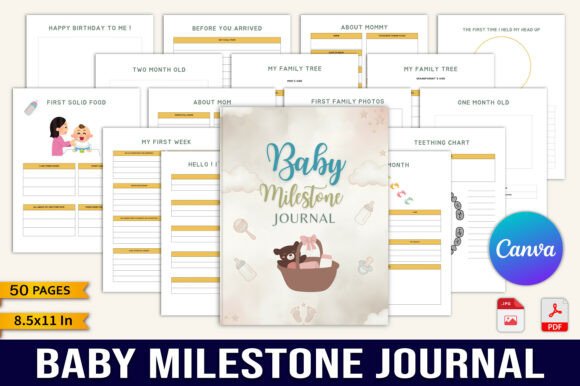
Before birth, sections like Finding Out We’re Expecting, Before You Arrived, and About Mom invite reflection—not as formal writing assignments, but as low-pressure prompts. These pages become part of prenatal planning alongside doctor visits, nursery setup, and birth plan drafting. They help ground anticipation in personal voice and intention, making the transition into parenthood feel more continuous and less fragmented.
During the first year, the journal becomes a responsive companion. Monthly spreads—from One Month Old to Twelve Month Old—offer consistent framing without rigidity. You don’t need to fill every line. Instead, you choose what matters *that month*: maybe it’s tracking teething patterns (Teething Chart), noting when solid foods were introduced (First Solid Food), or sketching a footprint next to My First Bath. The design avoids overwhelm by balancing structure (dates, measurements, prompts) with space for spontaneity (stickers, photos, doodles).
After the first birthday, the journal shifts from active use to archival function. Pages like Happy Birthday To Me, The Story Of How I Was Born, and My Family Tree gain deeper resonance when revisited—not as records, but as narrative threads connecting generations. This long-term value emerges not from volume, but from consistency: one thoughtful entry per week builds a cohesive, human-scale story.
Integration With Other Tools and Routines
The Baby Milestone Journal doesn’t replace other resources—it complements them. Pediatric visit notes, vaccination records, and ultrasound images can be tucked into pockets or referenced alongside relevant spreads (e.g., Growth Chart next to height/weight entries). Photos taken on smartphones can be printed at home or via a local lab and affixed to pages like First Family Photos or Home Sweet Home, bridging digital capture with physical permanence.
For working parents or those managing multiple responsibilities, the journal works best when treated like a recurring calendar event—not a daily obligation, but a biweekly touchpoint. Pair it with an existing habit: sip coffee while flipping to the current month’s spread; review last month’s notes during a pediatrician wait time; write a short reflection while baby naps. Its portability (standard 8.5" x 11" size, lay-flat binding) means it travels easily between home, daycare drop-offs, or grandparents’ houses.
It also interfaces well with shared caregiving. Sections like About Mommy, About Dad, and My Family Tree invite contributions from partners, grandparents, or siblings—turning documentation into collaboration. Handwritten notes from different voices add texture and perspective, reinforcing that milestones aren’t isolated events, but relational ones.
Design Choices That Support Real-World Use
Every icon and heading in the Baby Milestone Journal reflects tested usability—not decorative flair. Consider the Three Month or Six Month Old spreads: they include space for weight, length, head circumference, *and* open-ended observations (“What makes them smile?” “New sounds they make”). That duality—quantitative + qualitative—mirrors how pediatricians assess development and how parents actually experience it.
The World When You Were Born page grounds your child’s arrival in context: time zone, weather, headlines, even cultural moments. This isn’t trivia—it’s scaffolding for future conversations about identity, history, and belonging. Similarly, My First Home and Home Sweet Home prompt attention to environment and routine, helping parents notice subtle shifts in behavior tied to space, light, or sound—information often lost in verbal recollection.
Usability extends to material choices. Thick, acid-free paper accepts pen, pencil, watercolor, or glue without bleed-through. The durable cover withstands diaper bag jostling. And because there are no pre-filled dates or locked timelines, the journal adapts to babies born early, late, or via adoption—making it inclusive by design, not afterthought.
Practical Implementation Tips
- Start small. Fill out This Book Belongs To and Welcome to the World before birth—even if it’s just name and due date. That first act builds momentum.
- Batch entries monthly. Set aside 15 minutes at month’s end. Scan photos, check notes, and complete that month’s spread. Don’t chase perfection—capture essence.
- Use cross-references. Note “See Teething Chart, p. 42” in a monthly spread if a milestone relates to another section. This creates internal cohesion.
- Involve others intentionally. Leave space for grandparents to write a letter on Before You Arrived, or ask your partner to describe their favorite moment from month four.
- Revisit, don’t just record. Flip back every few months. Read past entries aloud to your baby—even at two months old, hearing your voice narrate their story builds connection.
Why Consistency Matters More Than Completeness
A fully filled journal is satisfying—but not necessary. What delivers enduring value is regular engagement, however brief. One sentence on My First Week (“She slept 45 minutes between feeds—exhausted but enchanted”) carries more emotional truth than ten bullet points copied from a checklist. The Baby Milestone Journal succeeds because it honors the uneven pace of early parenting: some weeks demand survival, others allow reflection. Its flexibility ensures that even sporadic use still yields coherence over time.
Long-term, this consistency pays off in quality control. Handwritten entries resist the algorithmic flattening of digital archives—no auto-deletion, no platform shutdown, no forgotten passwords. It remains accessible, tangible, and human-scaled. Years later, your child won’t scroll through a cloud folder—they’ll hold a book with smudged crayon marks, taped-in photos, and ink blots from a sleepless night. That’s not just documentation. It’s inheritance.
The Baby Milestone Journal doesn’t ask you to be a perfect parent. It asks you to be present, observant, and kind—to your baby, to yourself, and to the slow, unfolding work of becoming a family. In doing so, it transforms routine into ritual, memory into legacy, and a year of change into something you can hold, share, and return to—again and again.