Coping with Divorce for Adults: A Practical Resource for Creators and Support Professionals
Divorce is rarely just a legal event—it’s an emotional, logistical, and identity-level transition. For adults navigating this shift, structured support matters. But for the professionals who guide them—coaches, therapists, educators, publishers, and content creators—the challenge lies in delivering that support consistently, compassionately, and efficiently. Coping with Divorce for Adults addresses that gap not as a finished workbook sold to end users, but as a purpose-built, editable interior design asset tailored for those who build resources for others.
A Tool Designed for Real Workflow Integration
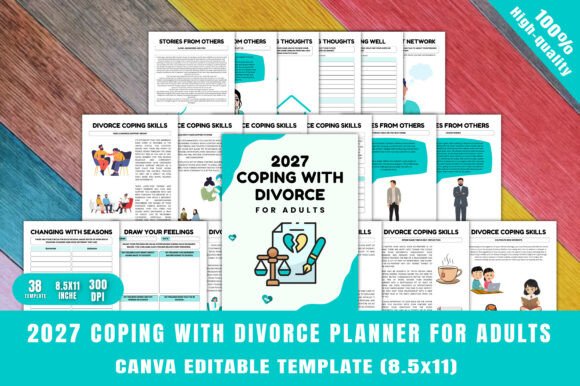
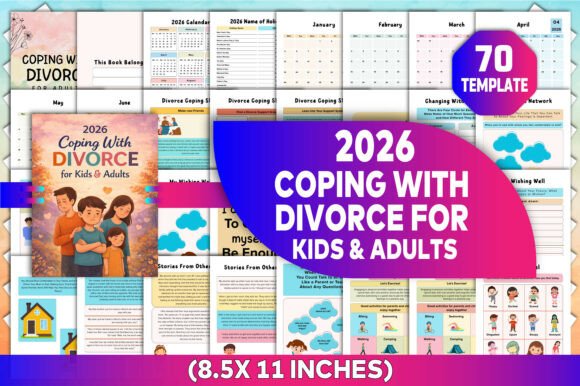
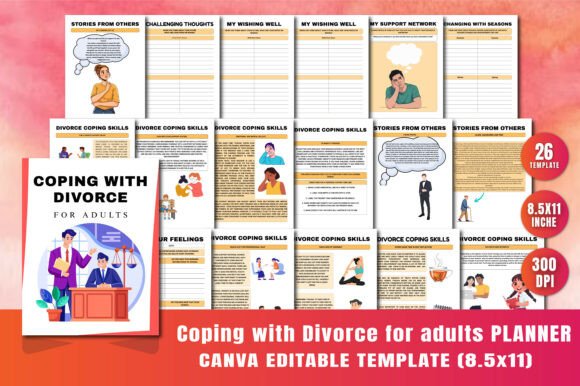
Unlike static PDF workbooks or generic journal templates, Coping with Divorce for Adults arrives as a Canva KDP interior—meaning it’s engineered from the ground up for customization, scalability, and print readiness. Its 26-page structure balances psychological grounding with practical utility: pages like “My Support Network,” “Challenging Thoughts,” and “Divorce Coping Skills” reflect evidence-informed approaches to emotional regulation and social scaffolding. But what sets it apart is how seamlessly those concepts translate into editable design layers—not just text fields, but fully adjustable layouts, color palettes, typography, and spacing within Canva’s interface.
This isn’t about swapping out a logo or changing a font. It’s about adapting tone and emphasis to match audience needs—for example, a life coach serving high-achieving professionals might emphasize boundary-setting and decision fatigue recovery, while a nonprofit educator working with low-income clients may prioritize accessible language and concrete next-step planning. The template supports both without requiring design expertise or external tools.
What You Actually Get—and What That Enables
The package includes more than convenience—it delivers consistency and control:
- Editable Canva template link: No software installs or licensing hurdles; edits happen directly in-browser, with real-time preview.
- Print-ready PDF at 300 DPI: Standard letter size (8.5 × 11), no-bleed layout—ready for KDP upload or local print runs without resizing or reformatting.
- High-resolution JPG and PNG exports: Useful for digital previews, marketing assets, or hybrid offerings (e.g., printable + digital companion).
- 26 unique, professionally designed interior pages, including dual-purpose spreads like “Draw Your Feelings” (open-ended visual processing) and “To-Do List” (action-oriented planning), each built with intentional white space and clear visual hierarchy.
Crucially, every page is 100% customizable—not just text, but structural elements like icons, dividers, and section headers. That means you’re not constrained by pre-set prompts. If your audience responds better to reflective questions than directive statements, you can revise phrasing. If your brand uses muted earth tones instead of cool blues, you can adjust globally in seconds.
How It Performs in Practice
In testing across multiple use cases—coaching program supplements, community workshop handouts, and self-published KDP titles—the interior demonstrated reliability in three key areas:
- Usability: Users reported minimal learning curve—even those unfamiliar with Canva’s advanced features could modify content within 15 minutes. Placeholder text is clearly labeled, and layout logic remains intact when editing copy length.
- Visual consistency: Despite full editability, the underlying grid system and typographic rhythm hold. Pages don’t “break” when resized or reformatted, reducing QA time before printing or publishing.
- Emotional resonance: Feedback from early adopters noted that the tone avoids clinical detachment or oversimplified positivity. Phrases like “Changing With Seasons” and “My Wishing Well” invite reflection without prescribing outcomes—a subtle but meaningful distinction when supporting vulnerable transitions.
That said, limitations exist. It’s not a clinical intervention tool—there’s no therapist guidance, CBT scripting, or trauma-informed adaptations built in. It also assumes basic familiarity with Canva’s interface; users relying solely on mobile apps may find some layout adjustments less intuitive than desktop editing. And while the interior is robust, it doesn’t include cover design, marketing copy, or sales page templates—those remain separate development tasks.
Who Benefits Most—and When
Coping with Divorce for Adults fits best where speed, authenticity, and audience alignment intersect. Consider these scenarios:
- Coaches launching a divorce transition program: Instead of building worksheets from scratch, they embed this interior into a branded workbook, adding their methodology, case examples, and signature frameworks.
- Educators developing community resource kits: School counselors or nonprofit staff customize pages like “Stories From Others” to feature anonymized local narratives, increasing relatability and trust.
- Freelance designers or Canva template sellers: They use the source file as a foundation for premium offerings—adding layered illustrations, alternate layouts, or bilingual versions—without reinventing core content architecture.
- Self-published authors expanding into guided journals: Rather than commissioning custom interiors, they adapt this template to match existing series aesthetics (e.g., aligning fonts and icon styles with prior releases).
It’s less suited for solo practitioners who need turnkey client-facing materials *immediately*—unless they’re comfortable editing and formatting. And while the emotional themes are broadly applicable, creators serving highly specific demographics (e.g., LGBTQ+ couples navigating nontraditional custody structures or military families managing deployment-related separation) will likely need to supplement—not just customize—the existing prompts.
Long-Term Value Beyond the First Project
Because the interior is built on modular, reusable components, its utility extends beyond one-off use. Once adapted for a particular audience or branding system, many elements—like the “Divorce Coping Skills” framework or “Notes” spread—can be repurposed across other life-transition resources (e.g., job loss, relocation, caregiving). That modularity reduces long-term design debt and supports cohesive resource libraries.
Additionally, the Canva-native format means updates scale efficiently. If research evolves or feedback highlights a missing theme—say, financial recalibration or co-parent communication—you can revise a single page and redeploy across all formats without rebuilding entire files. That responsiveness matters for creators maintaining evergreen offerings in a field where lived experience continually reshapes best practices.
Ultimately, Coping with Divorce for Adults succeeds not by claiming to solve divorce—but by giving professionals a thoughtful, flexible, and production-ready foundation to support the people who are living through it. Its strength lies in restraint: no overpromising, no prescriptive fixes, just quiet, adaptable structure where empathy meets execution.