Emotion Cards for Kids: A Practical Tool for Emotional Literacy and Classroom Support
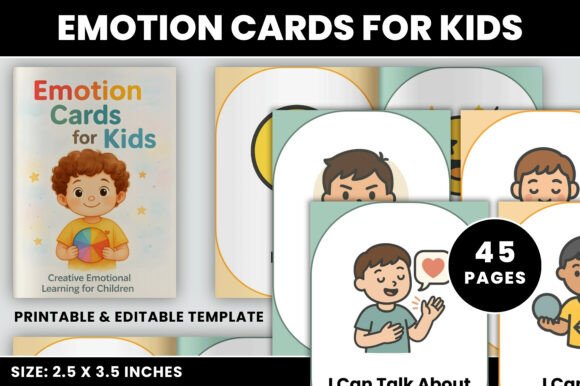
Emotion Cards for Kids are more than colorful flashcards—they’re a structured, developmentally grounded resource designed to help children name, recognize, and reflect on their internal emotional experiences. Unlike generic mood charts or abstract illustrations, these cards pair clear, child-friendly language (“I Feel Worried”, “I Feel Proud”) with expressive, inclusive visuals and intentional behavioral anchors (“I Can Listen”, “I Can Calm My Body”). What sets Emotion Cards for Kids apart is its dual focus: emotional identification *and* skill-building—bridging feeling recognition with concrete, actionable strategies.
How Emotion Cards for Kids Fits Into Real-World Practice
In homes, classrooms, therapy sessions, and after-school programs, adults often face the same challenge: how to support children when words fail them. A child who slams a door may not yet have the vocabulary—or the regulatory capacity—to say, “I feel overwhelmed.” Emotion Cards for Kids meet that gap by offering low-pressure, visual, and tactile entry points. The set includes 26 emotion statements (e.g., “I Feel Shy”, “I Feel Confused”) and 14 empowering “I Can” statements (e.g., “I Can Ask for Help”, “I Can Be Honest”), each designed to be introduced incrementally—not all at once. This scaffolding supports developmental readiness: younger children might begin with just five core emotions and two coping statements; older kids can explore nuanced distinctions like “disappointed” versus “frustrated” or “shy” versus “embarrassed.”
The interior design reinforces usability. Each card uses consistent typography, high-contrast color coding, and uncluttered layouts—critical for neurodiverse learners, English language learners, and children with attention differences. Facial expressions avoid exaggeration or ambiguity, prioritizing authenticity over theatricality. That intentional restraint helps prevent misinterpretation, especially for children who rely heavily on visual cues.
Editable Emotion Cards For Kids Interior: Flexibility Without Compromise
What makes Emotion Cards for Kids particularly adaptable is the editable interior format. You receive fully layered Canva files—no design software required. With a free Canva account, you can personalize names, adjust colors to match classroom themes, swap out illustrations, translate phrases, or simplify language for individual needs (e.g., changing “I Feel Overwhelmed” to “My body feels too full”). This isn’t just cosmetic editing: it allows educators and caregivers to align the resource with specific curricula, therapeutic goals, or cultural context—without sacrificing print quality.
You also receive high-resolution PDF, JPEG, and PNG files—optimized for both digital display and professional printing. The PDFs preserve vector clarity for crisp text at any size; the PNGs include transparent backgrounds for seamless integration into slides or interactive whiteboard activities; the JPEGs load quickly for email sharing or printed handouts. No hidden watermarks, no compressed previews—just production-ready assets from day one.
Comparing Formats: When Editable Cards Add Value
Pre-printed emotion card sets are widely available—but they offer little room for customization. If your school uses trauma-informed language (“I feel unsafe” instead of “I feel scared”), or your child responds better to animal metaphors (“My turtle shell is up” vs. “I feel shy”), fixed cards fall short. Similarly, subscription-based digital emotion apps often lock content behind paywalls or require internet access—barriers in low-resource settings or during travel.
Editable Emotion Cards for Kids sit between those extremes. They provide the consistency and intentionality of a professionally designed system, while granting control over implementation. Unlike DIY templates built from scratch—which demand time, design skill, and pedagogical knowledge—this resource delivers research-aligned content, then invites thoughtful adaptation. It’s comparable to choosing a well-structured curriculum guide over building lesson plans from zero: you retain agency, but start from evidence-informed foundations.
Strengths Worth Weighing
- Developmental range: Covers foundational emotions (happy, sad) and complex, socially embedded ones (left out, thankful, embarrassed)—supporting growth across ages 4–12.
- Behavioral linkage: Each “I Feel…” statement pairs with at least one “I Can…” action, reinforcing agency rather than labeling feelings as problems to fix.
- Accessibility-first design: Sans-serif fonts, ample white space, and consistent iconography reduce cognitive load without infantilizing content.
- Multi-setting utility: Works equally well for morning check-ins, social-emotional learning (SEL) lessons, behavior reflection journals, or parent-teacher collaboration tools.
Tradeoffs and Considerations
Editable files require basic familiarity with Canva—though no prior experience is needed, and Canva’s interface is intuitive for most adults. If your goal is instant plug-and-play use without *any* setup, a pre-printed physical deck may suit you better—even if it limits personalization. Likewise, if your work centers on clinical assessment (e.g., tracking symptom frequency or severity), you’ll likely need supplemental tools like standardized scales or progress trackers; Emotion Cards for Kids are intentionally formative, not diagnostic.
Also note: while the set includes 40 distinct statements, it doesn’t cover every possible emotional state—and shouldn’t try to. Depth matters more than breadth. Trying to add 100+ emotions risks diluting clarity and overwhelming users. This version prioritizes teachability, recall, and transfer: children are more likely to apply “I Can Talk About My Feelings” consistently if it’s practiced alongside just three or four core emotions, not twenty.
When Emotion Cards for Kids Are the Right Fit
This resource shines when you value both fidelity and flexibility—when you want structure *and* room to respond to real children, not hypothetical ones. It’s especially helpful if you:
- Support children with emerging emotional vocabulary or regulation challenges;
- Work across multiple settings (e.g., a school counselor who also leads parent workshops);
- Need materials that reflect diverse family structures, abilities, or cultural expressions of emotion;
- Prefer tangible, screen-free tools for grounding or transition moments;
- Want to involve children in co-creating their emotional toolkit—not just receiving it.
For example, a preschool teacher might print “I Feel Calm” and “I Can Take Turns” on sturdy cardstock, laminate them, and place them near the block area to prompt self-regulation during peer conflict. A therapist could edit the “I Feel…” cards to include client-specific metaphors (“I feel like my volcano is bubbling”) and export them as PNGs for a digital emotion journal. A parent might translate “I Feel Thankful” into their home language and add a photo of their child’s favorite activity to reinforce meaning.
When You Might Explore Alternatives
If your priority is real-time emotion tracking across weeks or months, consider pairing Emotion Cards for Kids with a simple spreadsheet or printable chart—not as a replacement, but as a complement. If you’re supporting teens with complex mental health needs, you may benefit from clinician-guided tools like the Feeling Words Wheel or dialectical behavior therapy (DBT) emotion logs, which emphasize physiological awareness and behavioral chains.
And if budget is the sole constraint, free printable emotion charts exist—but many lack developmental sequencing, inclusive representation, or intentional “I Can” scaffolding. Emotion Cards for Kids aren’t priced as luxury items; they’re investment-grade tools built for repeated, meaningful use—not single-lesson novelty.
Ultimately, Emotion Cards for Kids succeed not because they’re exhaustive, but because they’re intentional—designed to grow *with* children and the adults who guide them. They don’t promise quick fixes or universal solutions. Instead, they offer clarity, consistency, and quiet permission: to feel, to name, and—most importantly—to begin again.