Progress Notes Made for Therapists: The Smart, Flexible Way to Document with Confidence
Therapists spend hours each week documenting sessions—yet too often, that time feels like administrative overhead rather than clinical support. Paper forms fade. Generic templates don’t reflect your voice or your clients’ unique journeys. And trying to juggle multiple tools—note-taking apps, billing software, intake systems—adds friction where clarity is needed most. That’s why Progress Notes Made for Therapists has become a quiet game-changer for solo practitioners, group practices, and telehealth providers alike.
Not Just Another Template Pack—It’s Your Documentation Framework
This isn’t a static PDF you print once and abandon. Progress Notes Made for Therapists is built around one core idea: your notes should serve your practice—not the other way around. Every page is 100% customizable in Canva, meaning you’re not adapting to a rigid format—you’re shaping documentation to match how you think, how you work, and how your clients experience care.
Imagine opening your editable Canva template and instantly changing the color palette to align with your website branding. Or swapping out clinical jargon on your Mental Status Check page for plain-language prompts that resonate with neurodivergent clients. Or adding your logo to every invoice and consent form—without needing design skills or hiring help. That level of control isn’t just convenient—it reinforces consistency, professionalism, and trust across every client touchpoint.
What You Actually Get (and Why It Matters)
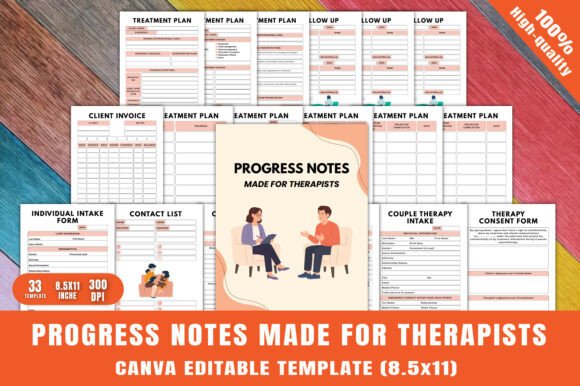
The package includes 33 unique, professionally designed pages, all structured around real-world clinical workflow—not theoretical best practices. Here’s how those pieces fit together in daily use:
- Individual Intake Form: Capture demographics, presenting concerns, history, and goals—all in one clean, empathetic layout. Editable fields let you add questions specific to your specialty (e.g., trauma screening items for EMDR clinicians, attachment prompts for family therapists).
- Mental Status Check Page: A streamlined, non-intimidating version of the MSE—designed to be completed *with* the client during session, not after. Swap checkboxes for sliders, adjust terminology (“affect” → “mood expression”), or embed brief psychoeducation right on the page.
- Progress Notes Pages (x3): Not carbon copies. One follows SOAP structure, another uses BIRP for behavioral health settings, and a third offers open narrative space with gentle prompts (“What shifted today?” “What felt most meaningful?”). All fully editable—no locked text boxes or invisible layers.
- Treatment Plan Pages (x8): Break long-term goals into measurable, collaborative steps. Add client-drawn visuals, timeline bars, or progress trackers. Use Canva to insert icons representing coping skills, grounding techniques, or relational patterns relevant to your modality.
- Couple Therapy Intake Page: Goes beyond “how long have you been together?” Includes shared values mapping, conflict style indicators, and co-created wellness goals—designed to invite both partners into the process from day one.
- Client Invoice & Consent Forms: Legally sound but human-centered. Adjust language to reflect informed consent as an ongoing conversation—not a signature event. Add QR codes linking to your privacy policy or telehealth platform instructions.
And because clinical work happens everywhere—from home offices to community centers—the files come in print-ready PDF, high-resolution JPG, and PNG formats, all at 300 DPI and standard letter size (8.5 × 11"). No cropping surprises. No blurry text. Just crisp, professional output—whether you’re printing hard copies for court referrals or embedding digital versions into secure client portals.
How Therapists Are Using This Beyond “Just Notes”
Practitioners are discovering unexpected versatility in Progress Notes Made for Therapists. One art therapist overlays her own line drawings onto the Notes Page, turning blank space into a co-created visual journal. A school-based counselor uses the To-Do List Page to track IEP follow-ups, parent contacts, and classroom observations—all in one glance. A bilingual clinician duplicates the Consent Form, translates key sections directly in Canva, and prints side-by-side Spanish/English versions without redesigning layouts.
Even supervision becomes smoother. Instead of redacting sensitive details from digital files, supervisors receive clean, branded Progress Notes Pages with only the clinical content they need—customized to highlight what’s most relevant for that supervisee’s growth area (e.g., transference themes, cultural humility markers, or session pacing).
Time Saved Isn’t Just Minutes—It’s Clinical Energy Reclaimed
We often talk about “time-saving” tools as if minutes were the only metric. But with Progress Notes Made for Therapists, the real return is cognitive load reduction. No more toggling between five tabs to find last month’s treatment plan template. No more rewriting the same discharge summary paragraph for the tenth client this year. No more second-guessing whether your intake form complies with updated state laws—because you control every word, and updates take seconds, not hours.
One private practice owner reported cutting documentation time by 40% in her first month using the editable Canva system. More importantly? She noticed her notes became more reflective, less rushed. Clients commented that she seemed “more present” during sessions—because she wasn’t mentally drafting paragraphs while listening.
Choosing the Right Tool Means Asking the Right Questions
If you’re evaluating Progress Notes Made for Therapists against other options—digital EHRs, free Google Docs templates, or custom-designed stationery—consider these practical factors:
- Ownership: With editable source files, you retain full rights. No subscriptions. No data stored on third-party servers. No risk of your template vanishing if a platform shuts down.
- Adaptability: Does it grow with your practice? Add group therapy pages? Shift from CBT to ACT frameworks? Accommodate new insurance requirements? Because every file is yours to edit, yes—it does.
- Integration: Works seamlessly with tools you already use—Dropbox for storage, HelloSign for e-signatures, QuickBooks for invoicing. No API headaches or IT support tickets.
- Accessibility: Adjust font sizes, contrast ratios, and spacing in Canva to meet WCAG guidelines—or create simplified versions for clients with low literacy or visual processing differences.
And perhaps most crucially: Does it feel like yours? When your documentation reflects your voice, your values, and your therapeutic stance, it stops being paperwork—and starts being part of your clinical presence.
Final Thought: Documentation Should Elevate Care—Not Distract From It
Good progress notes do more than satisfy audits or insurance reviewers. They hold memory. They trace change. They honor the complexity of healing. Progress Notes Made for Therapists doesn’t promise perfection—it promises partnership. A partnership between your expertise and a tool flexible enough to keep up, precise enough to protect, and thoughtful enough to remind you, every time you open that editable Canva link, why you chose this work in the first place.