2026 Eating Disorder Recovery
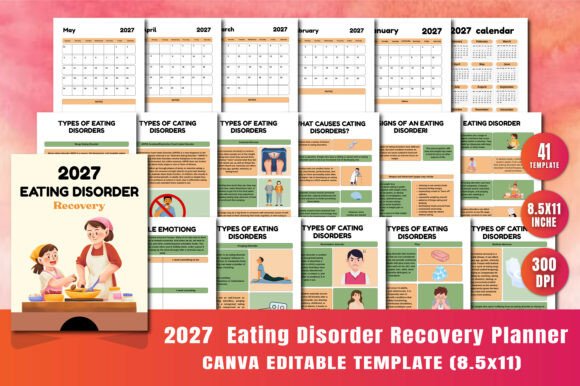
The 2026 Eating Disorder Recovery is not a standalone solution—it’s a structured, process-oriented tool designed to support sustainable behavioral change within real-world routines. It functions as both a reflective companion and an active planning system, built for adults who need clarity, consistency, and gentle accountability across recovery milestones. Whether you’re a clinician integrating tools into client care, a content creator developing wellness resources, or someone navigating personal healing, this planner meets you where you are: in the middle of life’s ongoing demands.
Its design reflects deep understanding of how recovery unfolds—not linearly, but iteratively. Pages like Hunger Fullness Awareness, Food Log, and Binge Context don’t ask for perfection. Instead, they create low-pressure space to observe patterns, reduce self-judgment, and gather data that informs next steps. That makes it especially useful before formal therapy begins (to build self-awareness), during treatment (to reinforce clinical work), or after discharge (to maintain progress without constant external support).
How It Fits Into Real Workflows
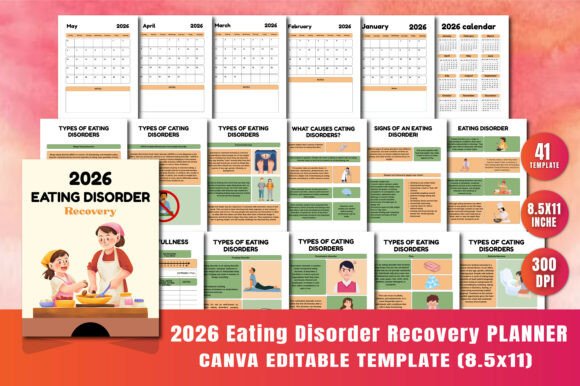
For professionals—therapists, dietitians, health coaches—the 2026 Eating Disorder Recovery serves as a ready-to-deploy extension of care. You can customize the editable Canva template to align with your practice branding, add intake notes, or embed session-specific prompts. Because it includes clinically grounded sections like Signs of an Eating Disorder and What Causes Eating Disorders, it doubles as an educational handout. Print-ready PDFs at 300 DPI ensure crisp reproduction for in-office use or client packets—no design overhead, no formatting delays.
Creators and publishers use it differently: as a foundation for scalable digital products. The 41 unique interior pages give you flexibility to repurpose content across formats—turn the Weekly Meal Planner into a standalone printable, adapt the Hunger Scale for an Instagram carousel, or combine My Vision and Food Tracker into a guided mini-course. Since all files are editable and include source layers, version control stays simple. You can produce seasonal updates (e.g., “2027 Edition”) without rebuilding from scratch—just swap dates, adjust colors, and re-export.
For individuals managing recovery alongside full-time jobs, caregiving, or creative projects, usability is non-negotiable. This planner avoids dense text walls and overwhelming structure. Its 8.5″ × 11″ no-bleed layout works seamlessly with standard home printers or KDP uploads. There’s no learning curve: open the Canva link, change fonts or accent colors in under two minutes, and download a polished PDF. That efficiency matters when energy is limited and motivation fluctuates.
Integration With Other Tools and Systems
The 2026 Eating Disorder Recovery doesn’t require isolation—it’s built to coexist. Pair it with habit-tracking apps by using the To-Do List and Exercise Mood pages to log qualitative insights that algorithms miss: how movement felt that day, what triggered a craving, or when satisfaction came from a meal—not just calories consumed. Use the Notes pages to synthesize app data with lived experience.
It also complements evidence-based frameworks. For example, those practicing intuitive eating can use Experience Your Food and Rediscover Your Food to deepen interoceptive awareness—the core skill behind honoring hunger and fullness cues. CBT-informed users find utility in Tackling Emotions and Binge Context, which guide reflection on thoughts, feelings, and environmental triggers without requiring clinical training to interpret.
For educators or workplace wellness coordinators, the planner integrates into broader programming. Assign the 2026 Monthly Planner as part of a year-long resilience curriculum. Use List Your Satisfying Foods in group workshops to normalize food preferences without moral framing. Because content is editable, you can remove or annotate sensitive sections (e.g., adjust language around weight or diagnosis) to meet organizational values or audience needs.
Practical Implementation Tips
Start small. Don’t feel obligated to complete every page daily. Choose one section—like the Hunger Scale—and commit to three entries per week. Consistency builds faster than volume.
Customize before printing. Use the Canva template to replace placeholder text with your own affirmations, modify color palettes to reduce visual fatigue (soft blues and warm neutrals often support calm focus), or increase font size for accessibility. These tweaks take minutes but significantly impact long-term use.
Leverage the blank space. The two dedicated Notes pages aren’t afterthoughts—they’re intentional buffers for insights that don’t fit predefined categories. Jot down observations about sleep, social interactions, or medication side effects. Over time, these become valuable context for clinicians or personal reflection.
Revisit, don’t replace. Unlike disposable planners, this one gains value with use. At month-end, flip back through your Food Log and Mood entries. Look for correlations—not to fix, but to understand. That kind of longitudinal tracking is rarely possible with digital tools that auto-archive or delete old data.
Quality Control and Long-Term Use
Because the files are print-ready at 300 DPI and formatted to KDP specifications (including bleed-free margins and CMYK-safe colors), there’s no risk of blurry text or misaligned pages when ordering physical copies. That reliability supports trust—both in the tool and in your ability to follow through.
Long-term viability also comes from modularity. If certain sections no longer serve your needs—say, Types of Eating Disorders becomes background knowledge—you can omit them in future versions. Or, if new goals emerge (e.g., reintroducing social eating), you can duplicate the Weekly Meal Planner and add custom prompts. The editable source files make adaptation frictionless.
Consistency isn’t enforced by the planner—it’s enabled by it. The 2026 Calendar and Monthly Planner provide scaffolding without rigidity. You decide whether to plan meals weekly or intuitively, track moods daily or only during transitions, or revisit My Vision quarterly rather than monthly. That autonomy reinforces agency—a critical factor in recovery outcomes.
Who Benefits—and How
This isn’t just for people in active treatment. Freelancers use the To-Do List and Exercise Mood pages to manage energy alongside deadlines. Bloggers repurpose Eating Disorder Overview and What Causes Eating Disorders into SEO-optimized resource posts. Small business owners bundle the planner with coaching packages, adding their logo and contact info via the editable template.
Even hobbyists—those journaling for personal growth—find value in its balance of structure and openness. The This Journal Belongs To page invites ownership. The Thank You Page closes the loop with gratitude, not obligation. That subtle emotional architecture supports sustained engagement far better than rigid productivity systems.
In short, the 2026 Eating Disorder Recovery works because it respects complexity. It assumes you’re capable, busy, and worthy of support that adapts—not prescribes. Whether you’re building a business, guiding others, or rebuilding your relationship with food, it offers practical scaffolding without oversimplifying the process.