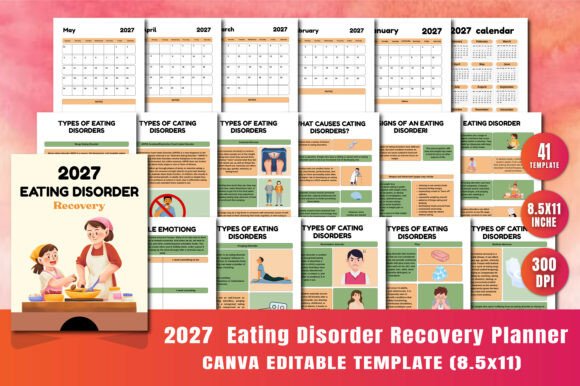
2027 Eating Disorder Recovery
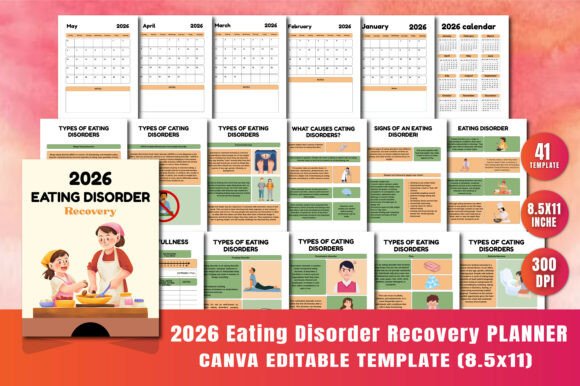
If you're navigating recovery in 2027—whether for yourself, a loved one, or as a clinician—you’re likely looking for tools that meet you where you are: grounded, flexible, and quietly empowering. The 2027 Eating Disorder Recovery Planner isn’t another rigid self-help system. It’s a thoughtfully structured companion designed to hold space for progress that isn’t linear—moments of insight, small wins, setbacks that teach, and quiet victories no one else sees.
What This Is—and What It’s Not
The 2027 Eating Disorder Recovery Planner is a print-ready, fully customizable KDP interior template built for real-life use—not just theory. It doesn’t claim to replace therapy, medical care, or nutritional guidance. Instead, it supports what happens between sessions: the morning when choosing breakfast feels like a negotiation, the afternoon when hunger cues are faint or confusing, the evening when reflection helps make sense of a day’s patterns.
It’s designed for people who want structure without rigidity—those who’ve tried apps that felt clinical or journals that asked too much too soon. This planner meets you with gentle prompts, evidence-informed frameworks (like hunger-fullness awareness and binge context tracking), and room to adapt. Its 28 core interior pages aren’t filler—they’re curated touchpoints aligned with recovery principles: self-compassion, embodied awareness, behavioral flexibility, and values-based action.
Where It Fits Into Real Life
For individuals in early recovery: Imagine waking up on January 3rd, 2027, and opening your planner to the “List Your Satisfying Foods” page—not as a diet list, but as a reconnection ritual. Or using the “Hunger Scale” alongside a simple food log not to count calories, but to notice how fullness shifts across meals. These aren’t tasks; they’re invitations to slow down and listen.
For those rebuilding after relapse: The “Binge Context” and “Exercise Mood” pages help uncover patterns without judgment—was that episode tied to isolation? Fatigue? A specific time of day? Tracking over weeks—not days—reveals what support actually looks like for *you*, not what recovery “should” look like.
For caregivers and supporters: You don’t need to be an expert to hold space. The “Types of Eating Disorders” and “Signs of an Eating Disorder” pages offer clear, stigma-free reference points—useful during family meetings, school conversations, or when advocating at a doctor’s office. No jargon. Just clarity.
For clinicians and wellness professionals: Many therapists, dietitians, and life coaches use this planner as a low-barrier adjunct tool—assigning one page per week, customizing prompts in Canva to match a client’s goals, or printing blank versions for in-session work. Its clean, uncluttered layout avoids triggering language (no “weight,” “calories,” or “good/bad” labels) while still supporting behavioral change.
Why Customization Matters—Especially Now
Recovery in 2027 looks different than it did even five years ago. More people are seeking neurodivergent-affirming, trauma-informed, or culturally responsive tools—and this planner adapts. With the editable Canva link included, you can:
- Swap fonts to reduce visual overwhelm for ADHD or dyslexic users
- Adjust color palettes to support emotional regulation (e.g., soft blues for calm, warm neutrals for grounding)
- Translate or simplify language for teens, non-native English speakers, or those with cognitive differences
- Add your logo or practice name if you’re a provider offering it as part of your program
That level of control means it grows with you—or your clients—rather than boxing anyone into a single approach.
Practical Considerations Before You Begin
This planner works best when used with intention—not obligation. If journaling has historically felt like another chore or source of shame, start small: one page a week, or even one sentence per day. The “Notes” and “Thank You” pages are intentionally open-ended, so there’s no pressure to “get it right.”
It’s also important to recognize its scope. While it includes foundational psychoeducation (“What Causes Eating Disorders?”, “Tackling Emotions”), it’s not a substitute for individualized treatment. If symptoms feel overwhelming, unsafe, or medically urgent, pairing this tool with professional support is essential.
And because it’s built for KDP and print, it’s optimized for tactile use—no screen fatigue, no notifications, no data tracking. That matters. For many, recovery begins when the digital noise fades and attention returns to the body, breath, and pen-on-paper rhythm.
Strengths That Show Up in Everyday Use
The 2027 Eating Disorder Recovery Planner stands out because it balances practicality with humanity. Its 300 DPI print-ready PDF ensures crisp text and clean lines—even when printed at home or through KDP. The no-bleed, letter-size (8.5″ x 11″) layout fits standard binders and printers, making it accessible whether you're using it solo or distributing it in a group setting.
Pages like “My Vision” and “Rediscover Your Food” gently shift focus from restriction to possibility—helping users reconnect with joy, culture, memory, and autonomy around eating. Meanwhile, functional tools like the “Weekly Meal Planner” and “To-Do List” reduce decision fatigue without prescribing meals or routines.
Even the structure supports sustainability: 2027 monthly spreads give long-term orientation, while daily tracking remains optional and low-pressure. You’re never behind. There’s no “missed day” penalty—just the next page, ready when you are.
Who Might Want to Explore Alternatives
This planner shines for people who value consistency, reflection, and gentle accountability—but it may not suit everyone. Those who prefer voice notes over writing, need real-time coaching feedback, or require highly specialized interventions (e.g., ARFID-specific strategies, OSFED-focused protocols) may benefit from supplementing it with other resources.
It’s also not built for rapid symptom stabilization in acute phases—when medical monitoring, meal support, or intensive outpatient care is needed first. In those cases, it serves best as a bridge toward independence, introduced once safety and stability are established.
A Tool That Honors Where You Are
At its heart, the 2027 Eating Disorder Recovery Planner reflects a simple truth: healing isn’t about erasing struggle—it’s about building a life where struggle doesn’t define you. Whether you’re using the “Experience Your Food” page to savor a piece of fruit without analysis, filling the “2027 Calendar” with therapy appointments and coffee dates alike, or circling back to “This Journal Belongs To” as a quiet reminder of your own worth—the planner holds space for all of it.
It’s not flashy. It won’t go viral. But for someone turning the page on January 1st—or March 14th—or any day they choose to begin again—it might be exactly the steady, kind, capable presence they’ve been waiting for.