Self-Care Journal: A Practical Tool for Sustainable Focus and Resilience
A Self-Care Journal isn’t a luxury—it’s infrastructure. For professionals, creators, educators, entrepreneurs, and anyone managing multiple roles, it functions as a grounded counterweight to constant output. It doesn’t replace task managers or calendars; instead, it anchors your workflow in sustainability by making care intentional, measurable, and repeatable. Think of it as the operating system layer that ensures your productivity tools run without overheating—physically, mentally, or emotionally.
Where It Fits in Your Real-World Workflow
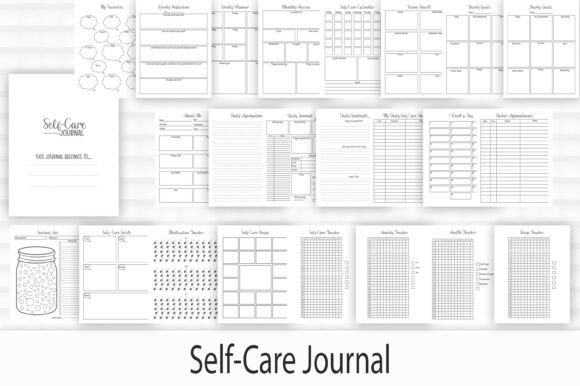
This Self-Care Journal integrates at three natural pressure points: before action, during execution, and after completion. Before launching a new project or campaign, use the Quarterly Goals and Vision Board pages to align effort with values—not just deadlines. During a demanding week, the Daily Self-Care Routine, Self-Care Tracker, and 1 Word a Day act as micro-checkpoints—small but consistent signals that recalibrate attention and energy. After a major milestone—or even a difficult conversation—you’ll find the Weekly Reflection and Monthly Review invaluable for spotting patterns: Which routines actually held up? Where did boundaries erode? What small habit quietly improved focus?
It also interfaces cleanly with digital tools. Use the Doctor Appointments and Medication Tracker pages alongside calendar reminders or health apps—then log outcomes in the journal to spot trends over time. Pair the Self-Care Bingo grid with team check-ins or accountability partners. The Weekly Planner works best when synced with your primary scheduling tool: block time for deep work, then intentionally block parallel time for rest or movement—and treat both with equal priority.
Designed for Consistency, Not Perfection
The 24-page structure avoids overwhelm while supporting depth. Each section serves a distinct function—and none require daily completion. You might fill Daily Gratitude most days, skip Yearly Goals until January, and revisit Self-Care Guide only when adjusting routines after travel, illness, or role changes. That flexibility is intentional. Long-term use depends less on rigid adherence and more on recognizing which pages serve your current season.
For example, freelancers juggling client deadlines often lean heavily on My Daily Self-Care Routine and Self-Care Tracker to prevent burnout between projects. Educators use Monthly Review and Weekly Reflection to assess emotional bandwidth across grading cycles and parent conferences. Small business owners rely on Quarterly Goals and Vision Board to stay mission-aligned amid operational firefighting.
Practical Implementation Tips
- Start with one anchor page. Choose the section you’re most likely to engage with consistently—like Daily Affirmation or 1 Word a Day. Build momentum there before expanding.
- Batch prep weekly. Every Sunday, glance at your upcoming week, then pre-fill Weekly Planner blocks and jot down three potential Daily Gratitude entries. This reduces friction during busy mornings.
- Use the tracker pages actively—not passively. Don’t just mark “yes” on Self-Care Tracker. Add a brief note: “Walked 20 min—felt calmer before call.” Over time, those notes reveal what truly restores *you*, not just what sounds good.
- Leverage the file formats strategically. The included AI, SVG, and high-resolution JPEG files let you customize layouts for print or digital use. Import the PDF into Notability or GoodNotes for handwritten reflection, or drop the SVG into Canva to build a printable version of your Self-Care Calendar with your own color scheme and fonts.
- Rotate focus quarterly. In Q1, emphasize Quarterly Goals and Vision Board. In Q2, prioritize Monthly Review and Weekly Reflection to refine execution. Let the journal evolve with your needs—not the other way around.
Compatibility and Real-World Usability
This Self-Care Journal was built for real constraints: tight schedules, shifting priorities, and variable energy levels. The CMYK color profile and 300 DPI resolution ensure crisp, professional printing—no washed-out affirmations or blurry trackers. The clean layout avoids decorative clutter, so you spend time reflecting, not deciphering design.
It works whether you’re handwriting with a fountain pen or typing into a tablet. The About Me and My Favorites sections help personalize context fast—no vague prompts like “What makes you happy?” Instead, you define your baseline: “My favorite way to reset is 10 minutes of silence with tea,” or “I recharge best in nature, not social settings.” That specificity makes future decisions faster: When choosing a lunch break activity, you already know what replenishes you.
For teams or collaborators, the Self-Care Bingo page doubles as a low-pressure engagement tool—especially useful in remote or hybrid settings where informal connection is harder to maintain. It’s not about performance; it’s about shared recognition of human limits and rhythms.
Quality Control Through Observation, Not Judgment
A key strength of this Self-Care Journal is its emphasis on observation over evaluation. The Daily Gratitude page doesn’t ask “What *should* you be grateful for?” It asks “What *is* true right now?” That subtle shift builds self-awareness without guilt. Similarly, the Self-Care Guide isn’t prescriptive—it’s a living reference you update based on experience. Did yoga drain you last month but energize you this month? Note it. That’s data—not failure.
The Medication Tracker and Doctor Appointments pages support continuity of care by keeping records in one place—reducing miscommunication during visits and helping you spot side effects or timing issues across prescriptions. Paired with Monthly Review, they turn routine health management into proactive insight.
Long-Term Integration: From Tool to Habit
Integration isn’t about adding another daily ritual. It’s about weaving care into existing ones. Keep the journal next to your morning coffee mug—not as another task, but as part of the pause before opening email. Use the Self-Care Calendar to visually map non-negotiable rest days alongside deadlines. Let the Yearly Goals page sit on your desk during annual planning, then fold it into your broader strategy doc—not as a separate artifact, but as evidence of holistic thinking.
Over time, the journal reveals what consistency really looks like for you—not uniformity, but responsiveness. Some weeks, Daily Affirmation matters most. Others, it’s the Weekly Planner that holds everything together. That variability isn’t inconsistency—it’s intelligent adaptation.
Ultimately, this Self-Care Journal supports one core outcome: maintaining capacity. Not just getting things done—but doing them with clarity, stamina, and integrity. Whether you’re launching a course, managing a classroom, editing a manuscript, or navigating caregiving, it helps you steward your most finite resource: yourself.