Student Success Method: A Practical, Adaptable Framework for Lifelong Learners
Learning doesn’t stop after graduation—it evolves. Whether you’re a working professional upskilling for a promotion, an entrepreneur mastering new tools, an educator refining lesson plans, or a freelancer building expertise across domains, structured self-direction is no longer optional. The Student Success Method meets this reality head-on—not as a rigid academic system, but as a customizable, human-centered workflow designed for clarity, consistency, and real-world application.
Why This Approach Fits How We Actually Work and Learn Today
Modern learning happens in fragments: a 20-minute podcast during a commute, a focused hour before work, a weekend deep-dive into a new framework. Traditional planners—overly prescriptive or built for full-time students—often clash with these rhythms. What’s gained traction instead is intentionality paired with flexibility: the ability to define priorities, track progress meaningfully, and adapt without starting over. That’s where the Student Success Method stands apart. It’s not about perfection—it’s about alignment between your goals, your time, and your energy.
This shift reflects broader changes: asynchronous work cultures, hybrid learning environments, and rising demand for demonstrable skill growth (not just credentials). Platforms like Canva have accelerated adoption by lowering barriers to personalization—no design experience needed, no subscription required to begin. With editable templates, users can adjust layouts, reorder sections, swap colors, or add custom fields—all while preserving clean typography and print-ready quality.
A System Built for Real Use—Not Just Aesthetic Appeal
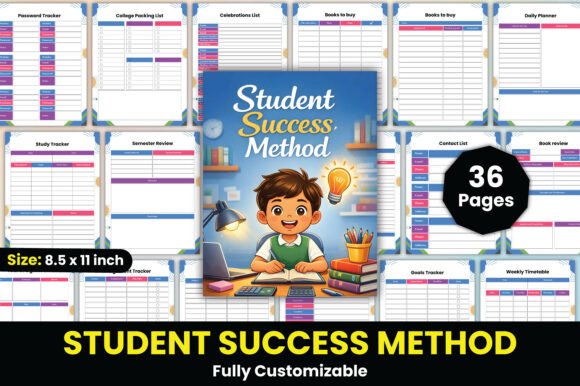
The Student Success Method Interior delivers 36 distinct, purpose-built pages—each sized at 8.5 × 11 inches, 300 DPI, with no bleed—so every file works seamlessly whether printed, shared digitally, or annotated in apps like GoodNotes or Notability. These aren’t decorative spreads. They serve concrete functions:
- Daily Planner, Daily Schedule, and Daily To-Do List help anchor attention when cognitive load is high—ideal for creatives juggling multiple clients or educators balancing instruction, grading, and prep.
- Class Schedule, Semester Planner, and Weekly Timetable support learners managing formal coursework alongside jobs or caregiving responsibilities.
- Examination Preparation, Study Tracker, and Semester Review encourage metacognition—helping users reflect on what strategies worked, where focus drifted, and how to adjust next time.
- Project Tracker, Assignment Tracker, and Course Overview bridge academic rigor with professional project management—valuable for freelancers launching client deliverables or marketers executing campaign timelines.
- Library Tracker, Book Review, and Books to Buy foster intentional knowledge curation, especially useful for researchers, writers, or lifelong learners building personal libraries.
Notice the repetition of “Tracker” and “Planner”—not as filler, but as evidence of design intent. Each tracker invites reflection, not just logging. Each planner includes space for context: “Why does this matter?” or “What support do I need?” That subtle shift—from task list to thinking tool—is what makes the Student Success Method sustainable beyond the first week of use.
Designed for Evolution—Not Just Completion
People don’t fail because they lack motivation. They stall when systems don’t evolve with them. A goal set in January may lose relevance by March. A course load may shift mid-semester. A freelance project may pivot unexpectedly. The editable Canva link included with every purchase ensures your system stays current—no need to buy new templates or rebuild from scratch. You simply open the file, duplicate a page, rename it (“Q3 Content Strategy Review”), adjust columns, and continue.
This adaptability aligns with how digital tools are now used: less as static documents, more as living workspaces. High-resolution PDF, JPEG, and PNG files mean you can share polished versions with mentors, embed visuals in presentations, or print crisp copies for desk reference—all from the same source. No pixelation. No layout shifts. Just fidelity across formats.
Practical Integration Across Roles and Routines
Consider how this works in practice:
- For educators: Use Weekly Goals to align lesson planning with student outcomes, then cross-reference with My Achievements to document growth over time—not just grades, but improved facilitation, inclusive practices, or curriculum innovation.
- For entrepreneurs: Pair Monthly Planner with Project Report to map product development milestones against revenue targets—and keep Password Tracker and Contact List updated without relying on fragmented notes.
- For professionals in transition: Leverage Things I Want to Learn, Goals Tracker, and Year at a Glance to visualize skill-building across quarters—not just “learn Python,” but “complete two data visualization projects by August, present findings to team in September.”
- For students balancing life and study: Combine College Packing List, Celebrations List, and Library Tracker to honor both logistical needs and emotional sustainability—because success includes rest, recognition, and joy, not just output.
None of these uses require mastery of complex software. The Canva interface is intuitive—drag, type, resize, export. And because all pages follow consistent spacing, font hierarchy, and grid logic, edits feel cohesive, not chaotic.
Quality That Supports Your Integrity—Not Just Your Output
“High-quality” here means more than resolution or color accuracy. It means thoughtful margins for binding, clear visual hierarchy so priorities stand out at a glance, and sufficient white space to prevent overwhelm. It means Course Overview and Project Report pages include prompts—not just headings—to guide reflection: “Key challenges encountered,” “What I’d do differently,” “Stakeholders involved.”
It also means ethical design: no locked layers, no hidden watermarks, no forced attribution. You own what you create—even if you start with a template. That respect for user agency is increasingly rare—and increasingly expected—by professionals who value autonomy, transparency, and long-term utility over short-term novelty.
More Than a Planner—A Practice in Self-Trust
At its core, the Student Success Method supports something deeper than productivity: the quiet confidence that comes from knowing your systems serve *you*, not the other way around. When your Weekly Assignments page includes space for “Energy level today (1–5),” or your Goals Tracker asks “What small win did I notice this week?”, you’re not just managing tasks—you’re cultivating awareness.
That awareness builds resilience. When deadlines shift or motivation dips, you’re not starting from zero—you’re reviewing data, adjusting variables, and continuing. That’s how habits form. That’s how capability compounds.
Thank you for visiting my product. If you’re ready to move beyond generic templates—and invest in a system that grows with your curiosity, adapts to your constraints, and honors your pace—this is built for you.