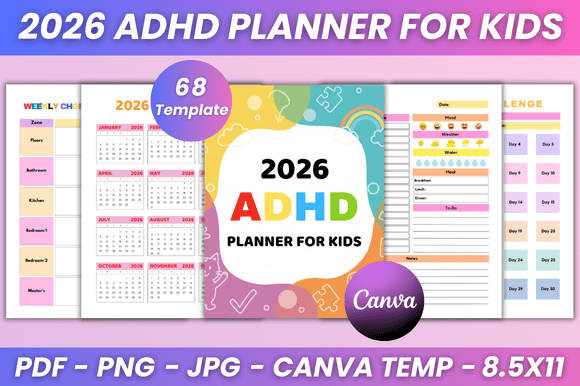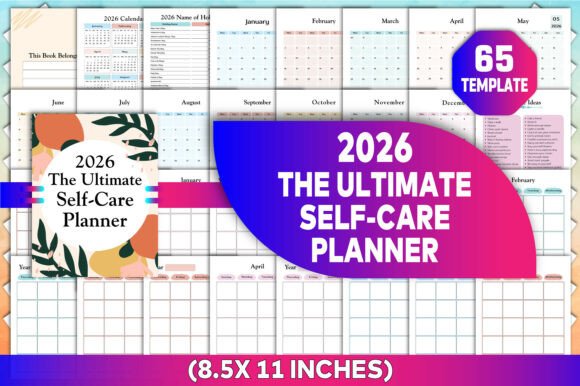
ADHD Self-Care Planner KDP Interior
If you’ve ever stared at a blank planner page wondering where to even begin—or tossed one aside after three days because it felt too rigid, too vague, or just *not built for how your brain works*—you’re not alone. The ADHD Self-Care Planner KDP Interior isn’t another generic productivity tool. It’s a grounded, flexible, and deeply practical resource designed specifically for adults who need structure that bends instead of breaks, reminders that feel kind instead of shaming, and self-care that fits into real life—not an idealized version of it.
This interior is built for two distinct but overlapping needs: creators preparing a physical planner for Kindle Direct Publishing (KDP), and individuals who want immediate, editable access for personal use. That dual-purpose design means every page serves both intention and usability—no wasted space, no confusing layouts, and zero assumptions about how “productive” you “should” be by noon.
Think about the small moments where support matters most: the freelancer juggling client deadlines while also trying to eat lunch before 3 p.m.; the educator recovering from back-to-back Zoom classes and needing a gentle nudge to hydrate, stretch, or pause; the parent with ADHD who wants to model self-compassion but keeps putting everyone else first. This planner meets those people *where they are*, not where productivity culture says they ought to be.
Where and When It Fits Into Real Life
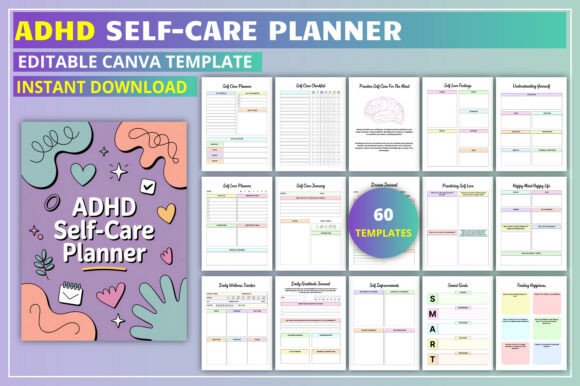
You don’t need a quiet morning, perfect lighting, or an hour of free time to use the ADHD Self-Care Planner KDP Interior effectively. Its strength lies in micro-moments: flipping to the Daily Wellness Tracker while waiting for coffee to brew, jotting a quick Self-Talk reflection during a 10-minute break between meetings, or scanning the Self-Care Bucket List when energy dips mid-afternoon—not as a to-do, but as inspiration.
For KDP creators, this interior is ready to drop straight into Amazon’s formatting requirements. The PDFs are print-ready, bleed-free, and sized precisely for 6" x 9" or 8.5" x 11" formats—no guesswork, no last-minute cropping disasters. And because it includes JPG and PNG files alongside the PDF, you can easily adapt cover mockups, social media previews, or listing thumbnails without opening heavy design software.
For Canva users, the editable link opens directly into a fully layered, intuitive layout. You’re not stuck with preset fonts or colors. Want to swap out the sage green headers for deep navy to match your brand? Done in under a minute. Need larger checkboxes for easier tapping on a tablet? Adjusted instantly. Even non-designers find themselves customizing text boxes, swapping icons, or adding their own affirmations—because the system invites participation, not passive consumption.
Real Use Cases Across Roles and Routines
A freelance writer uses the 30-Day Self-Care Challenge page to pair writing sprints with intentional recovery—like “write for 45 minutes, then step outside barefoot for 3 minutes.” They copy the challenge into their Notion dashboard but keep the printable version on their desk for tactile accountability.
An online course creator adapts the Self-Love Affirmations and My Gratitude Log pages into bonus materials for students—customizing wording to reflect learning resilience (“I grow through confusion”) and exporting clean PNGs for email sequences.
A high school counselor prints single-page excerpts—like the Self-Care for the Mind checklist or Dream Journal prompt—to hand out during stress-management workshops. The clean, uncluttered design avoids sensory overwhelm, and the open-ended prompts invite reflection without pressure.
A small business owner launching a wellness coaching service uses the editable Canva file to insert their logo, rebrand the Wellness Goals tracker with client-facing language (“What energizes you?” vs. “What depletes you?”), and turn it into a signature onboarding worksheet—all in one afternoon.
What to Consider Before Using It
This planner won’t fix burnout overnight—and it’s not meant to. It works best when treated as a responsive companion, not a rigid rulebook. If you’re new to self-care planning with ADHD, start with just *one* section: maybe the Daily Wellness Tracker for three days, or the I’m Grateful page before bed. Consistency builds from repetition—not perfection.
Also consider your output preference. If you rely heavily on digital tools like Obsidian or Apple Notes, the printable format may feel limiting unless you scan and annotate pages later. But if handwriting helps you process emotions or anchor attention, the physical act of checking off a Self-Care Checklist item or circling a feeling in the Self-Love Feelings wheel creates a subtle but powerful neurological cue.
And if you’re publishing via KDP: test-print a few pages first. While the interior is optimized for KDP’s guidelines, paper stock, binding method, and printer calibration all affect how colors and spacing appear. A $5 proof copy saves hours of revision later.
Why the Details Matter—Not Just the Design
The Belongs To Page isn’t decorative—it’s a quiet act of ownership. For someone who’s spent years feeling like their time, energy, or needs were secondary, seeing their name printed there shifts something internal. The Self-Care Journey spread doesn’t ask for milestones—it asks for “what shifted?” That tiny reframe honors progress that isn’t linear.
The Dream Journal and Happy… prompts aren’t filler—they’re invitations to reconnect with joy in ways that bypass executive function hurdles. You don’t need to write paragraphs. One word. A sketch. A song title. A memory fragment. That’s enough.
Even the Gratitude Letter page is structured to reduce friction: pre-written sentence starters (“I appreciate how you…”, “One thing I noticed about you…”), space for names and dates, and room to seal it—even if you never send it. The act of writing is the point.
Ultimately, the ADHD Self-Care Planner KDP Interior succeeds not because it’s “comprehensive,” but because it’s considerate. It assumes you’re already doing your best. It leaves room for rest, revision, and redirection. And whether you’re holding a printed copy, editing in Canva, or uploading to KDP, it meets you with clarity—not clutter.